
Landing Page or Homepage: Which Converts Paid Traffic into Leads?
Someone searches for CRM automation for real estate teams. They click your ad. They land on your homepage, where a banner talks about innovation, the menu offers seven options and three buttons ask for three different things.
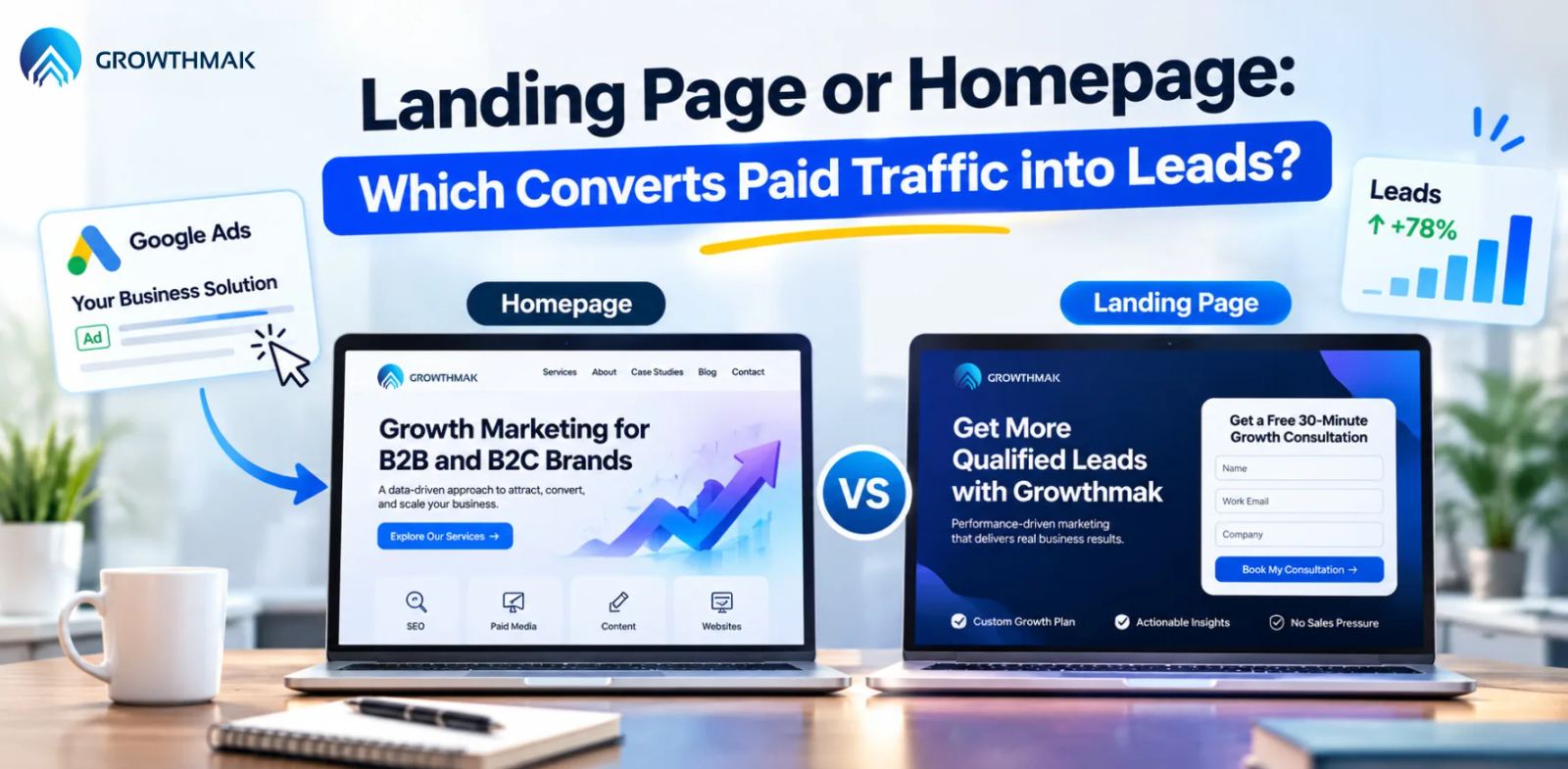
They leave within seconds. Tomorrow you pay for the same click again.
This is one of the most common leaks in paid search. The ad did its job. The page it pointed to did not, because it was never built for that searcher.
The landing page vs homepage for ads question decides how much of your budget turns into pipeline. This guide gives you a clear answer, plus:
- When a homepage is genuinely the right destination
- What Google evaluates on the page you send traffic to
- The seven elements of a Google Ads landing page that converts
- How many landing pages you actually need
- How to test and improve them without guesswork
Should Your Google Ads Landing Page Be Your Homepage?
For most campaigns, no. A dedicated Google Ads landing page converts paid traffic better because it matches one search intent, repeats the promise in the ad, offers a single action and removes the distractions a homepage carries. Your homepage is built to introduce the whole business to every type of visitor. Send traffic there mainly for brand searches, where people are looking for your company by name, or when your business sells one clear offer. For every other campaign, build a focused page for each distinct intent.
Why Homepages Struggle With Paid Traffic
A homepage has to serve everyone: prospects, partners, job seekers, existing clients and curious visitors. That makes it broad by design, and broad pages rarely answer one specific search well.
It also offers too many choices. Hick's law describes how decision time grows as the number of options increases. Every extra menu item and button gives a paid visitor another way to delay, wander or leave.
Then there is message mismatch. If the ad promised one thing and the page opens with another, the visitor has to work to connect them. Most will not. We cover more of these leaks in our guide on why Google Ads generate clicks but not customers.
Landing Page vs Homepage for Ads: Side by Side
A landing page is any page a visitor arrives on, but in paid search the term usually means a standalone page built for one campaign goal. Here is how the two compare.
| Factor | Homepage | Dedicated landing page |
|---|---|---|
| Purpose | Introduce the whole business | Convert one intent into one action |
| Audience | Every visitor type | Searchers from one keyword group |
| Navigation | Full menu and many exits | Minimal, with essential trust links only |
| Calls to action | Several competing actions | One action, repeated where it helps |
| Message match | General brand message | Mirrors the search and the ad copy |
| Testing | Risky, because changes affect all traffic | Safe to test without touching the main site |
| Best for | Brand searches and exploration | Non-brand, high-intent paid campaigns |
Neither page is better in every case. The right destination depends on what the searcher already knows and what you want them to do next.
When Your Homepage Is the Right Destination
There are a few situations where sending paid traffic to the homepage makes sense:
- Brand campaigns, where people search your company name and want the main site
- Businesses with a single core offer that the homepage already presents clearly
- Short tests before you have enough data to justify a dedicated page
Even then, check that the homepage passes the landing page test. The first screen should state what you do, who it is for and what to do next, with one primary action.
What about your existing service pages? They sit between the two options. A strong service page can work for paid traffic if it matches the search closely and carries one clear action. If it still has the full menu, several offers and generic copy, treat it like a homepage and build a focused version instead.
What Google Looks At on Your Landing Page
In Google Ads, Quality Score has three components: expected clickthrough rate, ad relevance and landing page experience. Landing page experience reflects how relevant and useful your page is to people who click your ad.
Google states that Quality Score is not an input in the ad auction. It is a diagnostic tool, but the factors behind it do shape ad performance and costs, so a relevant, useful page is never wasted effort.
Watch Performance Max closely. Its Final URL expansion setting is turned on by default, which lets Google send visitors to pages it judges more relevant, sometimes your homepage. Exclude URLs you do not want used, or turn the setting off. It is one of the first settings worth reviewing in any Google Ads management audit.
Anatomy of a Google Ads Landing Page That Converts
Strong landing pages share the same seven elements. Get these right before you test anything clever.
1. Match the Headline to the Search
Your headline should repeat the problem the visitor just typed, in similar words. If the search was CRM automation for real estate teams, the page should say exactly that above the fold.
This instant match tells the visitor they are in the right place, which is the first thing they decide.
Support the headline with a one-line subhead that states the outcome, and an image of the real service, team or product rather than stock art. Together they should answer what this is and why it matters before any scrolling.
2. Give One Offer and One Action
Choose one call to action and design the whole page around it. Repeat it lower down for people who scroll, but never compete with it.
Match the offer to intent. Problem searches suit a free audit or guide. Comparison and pricing searches suit a call or a quote.
Make the button text specific. Book my free audit tells the visitor what happens next. Submit tells them nothing.
3. Put Proof Beside the Form
Visitors hesitate at the moment of action. Place a short, relevant testimonial, a case result the client approved or partner credentials right next to the form, not three scrolls away.
Match the proof to the ad group. An industry campaign needs a case from that industry. A service campaign needs proof of that service. Generic praise near the form does far less than one specific, relevant result.
4. Ask Only for What Sales Needs
Every field adds effort. Keep the ones your team will use to qualify and route the lead, and drop the rest.
One or two qualifying questions, such as company size or timeline, can raise lead quality without hurting volume much. Test this rather than assuming it.
5. Load Fast on Mobile
Much paid traffic arrives on phones, often on ordinary connections. Compress images, avoid heavy scripts and test the page on real devices, not only on a desktop preview.
Use Google's Core Web Vitals as your benchmark: the main content should render within 2.5 seconds for most real visits. On mobile, keep the form or a tap-to-call button within easy reach, so acting never takes more than one thumb movement.
6. Remove Exits, Keep Trust Links
Strip the main menu and outbound links that pull people away. Keep your logo, a privacy policy and one or two trust links, so visitors can verify the business without abandoning the offer.
Keep the footer short as well. A clickable phone number and your business address reassure buyers far more than a full sitemap of links.
7. Track Every Lead to Its Keyword
Use UTM parameters and hidden form fields to pass campaign, ad group and keyword into your CRM. Without this, you optimise for form fills instead of qualified leads.
If you run paid social as well, the same principle applies. Our guide to turning Meta Ads leads into customers covers it in detail.
How Many Landing Pages Do You Actually Need?
You do not need one page per keyword. You need one page per distinct intent, meaning a group of searches that share the same problem and the same offer.
| Campaign intent | Example search | Page to send it to |
|---|---|---|
| Brand | Growthmak agency | Homepage or main services page |
| Problem | Why is my website not getting leads | Problem-focused page with a free audit offer |
| Service | Landing page optimization services | Dedicated service landing page with a call booking |
| Industry | Google Ads agency for manufacturers | Industry page with sector-specific proof |
| Comparison | In-house team vs marketing agency | Comparison page with a consultation offer |
Most B2B accounts start with three to five pages and add more as search term data shows new intent groups worth serving.
PPC Landing Page Optimization: Test, Learn, Repeat
PPC landing page optimization is never finished. Use A/B testing to compare one change at a time, such as the headline, the offer or the form length, and run each test long enough to reach a reliable result.
Resist stopping a test early because one version had a lucky week. Wait until both versions have enough conversions to compare with confidence, then keep the winner and test the next element.
Judge tests by qualified leads and pipeline, not just conversion rate. A page that doubles form fills with poor-fit leads is a step backwards, as we explain in why lead quality matters more than cost per lead. For more ideas to test, see our proven CRO tactics.
Keep Lead Forms on the Right Side of Privacy Law
Landing pages collect personal data, so privacy rules apply. Visitors in the EU are covered by the GDPR, the UK has its own equivalent, and India's Digital Personal Data Protection Act, 2023 sets consent and notice duties for personal data.
- Link a clear privacy notice near the form
- Collect only the data you need for the stated purpose
- Keep marketing consent separate and unticked by default
- Store consent records alongside each lead in your CRM
A Pre-Launch Checklist for Every Landing Page
Run this list before any campaign goes live. It takes minutes and prevents the errors that waste the most budget:
- The headline matches the keyword group and the ad copy
- There is one primary action, and every button leads to it
- Relevant proof sits within sight of the form
- The form sends a test lead to the CRM with source data attached
- The conversion tag fires once per lead, not twice
- The page loads quickly on a real phone over mobile data
- The privacy notice is linked and consent wording is clear
- Performance Max URL exclusions are set where needed
What a Landing Page Will Not Fix
A great page cannot rescue the wrong keywords, an offer nobody wants or a broken conversion tag. Fix targeting and tracking first.
Nor can it save a lead your team calls back three days late. Speed of follow-up often decides whether a lead becomes a customer, which is why we wrote about what happens in the first 72 hours.
When to Bring In Conversion Rate Optimization Services
If paid traffic is steady but cost per qualified lead keeps rising, the page is usually the bottleneck. That is the point where structured conversion rate optimization pays for itself.
A conversion rate optimization audit is the fastest start. At Growthmak it runs 2 to 3 weeks and ends with a prioritised fix list. From there, ongoing landing page optimization services and conversion rate optimization services keep testing so results compound rather than stall.
Final Thoughts: Landing Page or Homepage?
Send non-brand paid traffic to a dedicated Google Ads landing page, and keep the homepage for brand searches and single-offer businesses.
The condition that flips the answer is intent. If the searcher already knows you and wants the main site, the homepage wins. If they searched a problem or a service, a focused page wins.
Start today: list every final URL in your account, flag campaigns that point at the homepage, and build one landing page for your highest-spend intent group. Then apply steady landing page optimization from there.
Turn More Paid Clicks Into Leads With Growthmak
Growthmak's Conversion Layer turns existing traffic into revenue through landing pages, funnels, structured testing and message match between ads and pages. Before you scale spend, plan it with our free Google Ads budget calculator.
Start with a free 30-minute diagnostic and receive a written plan within one day. Book your free Growthmak diagnostic and find out where your paid traffic is leaking.
Frequently Asked Questions
Send most Google Ads traffic to a dedicated landing page that matches the search, the ad and one offer. Use the homepage mainly for brand searches, where people are looking for your company and want to explore the full site.
A good Google Ads landing page repeats the searcher's intent in the headline, offers one clear action, shows relevant proof near the form, asks only for necessary details, loads quickly on mobile and tracks every lead back to its keyword.
It can. Landing page experience is one of the three Quality Score components, alongside expected clickthrough rate and ad relevance. Quality Score itself is a diagnostic, but the factors behind it influence ad performance and what you pay.
Build one landing page per distinct search intent, not per keyword. Group keywords that share the same problem and offer, then give each group its own page. Most B2B accounts start with a handful of pages and expand as data arrives.
Usually not. Removing the main menu cuts exits and keeps attention on one action. Keep the logo, a privacy policy link and essential trust links, so visitors can still verify the business without wandering away from the offer.
PPC landing page optimization is the ongoing process of improving pages that receive paid traffic. It covers message match, layout, proof, form design and speed, tested one change at a time, so you learn which improvements actually raise qualified leads.
A conversion rate optimization audit reviews tracking, funnel drop-off, page experience, messaging, forms and speed to find where visitors leave. At Growthmak, a CRO audit runs 2 to 3 weeks and ends with a prioritised fix list.
Performance Max has Final URL expansion turned on by default, so Google may send visitors to pages it considers more relevant, including your homepage. Exclude unwanted URLs in campaign settings or turn the feature off if you need tighter control.
Written by Growthmak Team · B2B Growth Specialists
All blogs