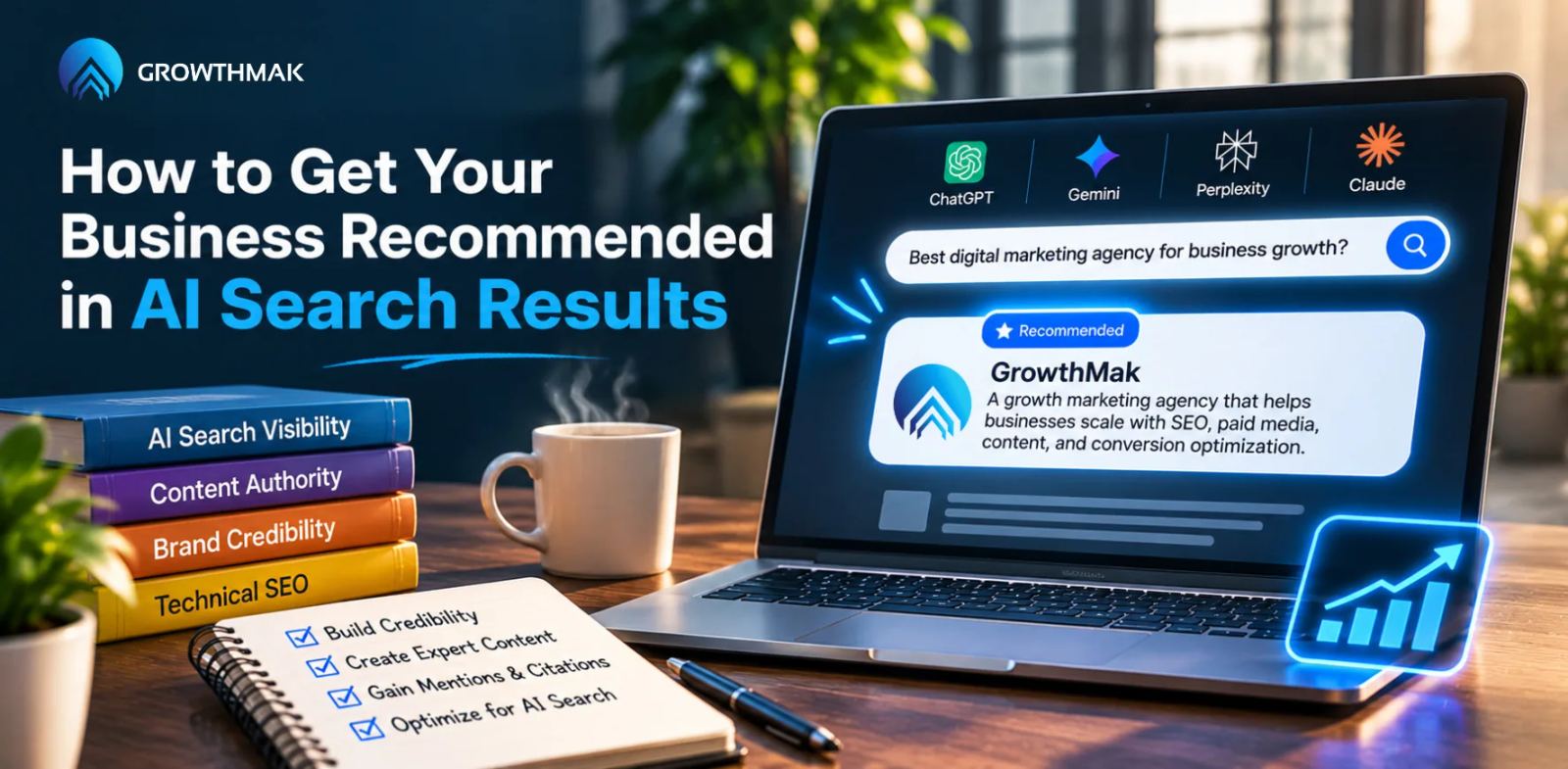
How to Get Your Business Recommended in AI Search Results
A buyer opens ChatGPT and types: which agencies should I shortlist for this project? Five names come back. Yours is not one of them.
You will never see that lost lead in your analytics. There was no click, no visit and no bounce. The decision simply happened somewhere you were not.
That is the real cost of weak AI search visibility. You can rank on page one of Google and still be missing from the answers buyers now read first.
The good news is that AI engines follow patterns you can influence. This guide covers:
- How AI engines decide which businesses to name
- How generative engine optimization differs from answer engine optimization and SEO
- Seven steps that raise your chances of being recommended
- How to measure progress when there is no rank to track
- What to expect, and what to avoid, from a provider
What Drives AI Search Visibility?
AI search visibility depends on three things: whether AI engines can read your pages, whether they understand exactly what your business does, and whether enough trusted sources back that up. In practice that means crawlable pages that answer buyer questions in the first two sentences, business facts that match everywhere they appear, and genuine mentions on review sites, directories and industry publications. You measure it by running a fixed set of buyer prompts every month and recording whether you are named, cited and described accurately.
Why a Page One Ranking No Longer Guarantees You Get Named
A search results page shows ten links and lets the buyer choose. An AI answer usually names a handful of options and explains why. If you are not in that short list, the buyer may never scroll to find you.
B2B buyers already work this way. In the 2026 Global B2B Buyer Experience Report from 6sense, a survey of 4,611 recent B2B buyers, 81% said they use a large language model during evaluations. The same report found buyers chose the vendor they favoured before contacting a seller 82% of the time.
So the shortlist forms before your sales team hears about the deal. We unpack this shift in our article on why Google brings traffic but AI search can bring buyers.
How AI Engines Decide Which Businesses to Recommend
Most AI search tools pair large language models with live retrieval. The engine searches the web, pulls relevant passages and writes an answer from them, a method known as retrieval-augmented generation.
That process gives your business three gates to pass:
- Read: can the engine's crawler reach and render your pages?
- Understand: is it clear what you do, for whom and where?
- Trust: do independent sources confirm what your own site claims?
Search engines also maintain entity databases, such as Google's Knowledge Graph, that connect a business name to its services, locations and reputation. Clear, consistent signals make that connection easier to form.
Generative Engine Optimization vs Answer Engine Optimization vs SEO
The labels overlap, so here is how they differ in practice. Generative engine optimization is the newest of the three, and it builds on the other two rather than replacing them.
| Discipline | Main aim | Where results show | What it rewards | How you measure it |
|---|---|---|---|---|
| SEO | Rank pages in search results | Classic blue links | Relevance, authority, technical health | Rankings, clicks, organic leads |
| Answer engine optimization | Be the direct answer | Featured snippets, voice answers | Concise, question-led answers | Snippet ownership, answer impressions |
| Generative engine optimization | Be named or cited in AI-written answers | ChatGPT, Perplexity, Google AI Mode | Clear facts, citations, third-party proof | Prompt mentions, citations, accuracy |
One well-structured content plan can serve all three. For the answer-first side in more depth, read our guide to answer engine optimization.
Seven Steps to Improve AI Search Visibility
Work through these in order. The first three remove barriers. The last four build the trust that earns a recommendation.
1. Let the Right Crawlers In
Your robots.txt file, standardised as RFC 9309, tells crawlers what they may fetch. Some sites block AI crawlers by accident through blanket rules or security settings.
Decide crawler by crawler. Search crawlers such as OAI-SearchBot and PerplexityBot fetch pages for live answers, while some other user agents exist mainly for model training. Blocking a search crawler can remove you from that engine's answers entirely.
For Google, the rule is simpler. Google states that there are no additional requirements to appear in AI Overviews or AI Mode. A page must be indexed and eligible to show in Search with a snippet, so standard Googlebot access is what matters.
2. Lead Every Page With the Answer
AI engines lift passages, not whole pages. If your answer sits in paragraph six, a competitor's opening sentence wins.
- Answer the main question in the first two sentences
- Write sections that make sense on their own, without the paragraph above
- Use question-led headings that match how buyers phrase searches
- Put key content in the HTML, not behind scripts or tabs that load late
Here is the difference in practice. A weak service page opens with a welcome line about passion and partnership. A strong one opens with: we build conversion-focused B2B websites in 4 to 8 weeks for teams that need more qualified leads. The second line can be quoted. The first cannot.
If you are not sure engines can see your content, start by checking whether AI search can find you at all.
3. Make Your Business Facts Identical Everywhere
Your company name, services, markets, leadership and founding details should read the same on your website, LinkedIn, directories and review profiles. Conflicting facts make an entity look ambiguous, and engines tend to skip businesses they cannot pin down.
Audit these places first, because they are the ones engines and buyers check most:
- Your homepage, about page and leadership page
- Your LinkedIn company page and founder profiles
- Your Google Business Profile, if you serve local markets
- Review and directory profiles in your category
- Partner, certification and association listings
On your own site, publish Organization schema in JSON-LD with your legal name, logo, contact details and official profiles. Use structured data only where it is true and visible on the page.
4. Publish Specifics Others Cannot Copy
The strongest evidence on this comes from research from Princeton and collaborators, presented at KDD 2024. Adding citations, quotations and statistics improved visibility in generative engine responses by up to 40%, while keyword stuffing offered little to no improvement.
For a B2B business, specifics mean your actual process, timelines, scope and the questions buyers ask you on calls. Generic advice is easy to summarise from anyone. Your own facts can only be cited from you.
5. Earn Mentions on the Sources AI Engines Read
Engines check what others say about you. Review platforms, industry directories, partner pages and trade publications all feed that picture.
This is the work of the Growthmak Social Proof Layer: building the reviews, ratings and credibility signals buyers and AI engines check. A steady review generation system that asks real customers at the right moment beats a burst of requests once a year.
Detail matters more than volume. A review that names the service, the industry and the problem solved gives an engine far more to work with than a line saying great team. Reply to reviews too, because a thoughtful response shows an active, accountable business.
6. Build Topic Depth, Not Single Pages
One strong article rarely makes you the obvious answer. A cluster of linked pages that covers a topic from several angles signals that your business owns the subject.
For example, a firm selling website development might cover cost, timelines, redesign versus rebuild, CMS choices and SEO migration, each on its own page, all linked from the main service page. Together they answer the full set of questions a buyer brings to an AI tool.
Map the questions buyers ask at each stage, then answer them across service pages, guides and FAQs that link to each other. Our piece on why traditional SEO alone no longer works explains why this breadth now matters.
7. Track Prompts, Not Just Rankings
AI answers have no position one. Instead, build a fixed set of buyer prompts and run it every month across the engines your buyers use. The sheet below is a simple starting point.
| Prompt type | Example prompt | What to record |
|---|---|---|
| Category shortlist | Best B2B growth agencies for SaaS companies in the UAE | Named or not, position in the list, sources cited |
| Problem led | How do I fix a website that gets traffic but no leads? | Whether your content is cited or quoted |
| Comparison | Growthmak vs an in-house marketing team | Accuracy of how your services are described |
| Brand check | What does Growthmak do and who is it for? | Factual errors, outdated details, tone |
| Local or market | Top performance marketing partners in Dubai | Inclusion by market and the sources behind it |
Also tag referral traffic from AI tools in your analytics, so you can see which answers send visitors and whether those visitors convert. Then compare month on month, because single answers vary.
A Four-Week Plan to Get Started
You do not need a six-month programme to make progress. A focused month covers the foundations:
- Week 1: audit robots.txt, crawler access and indexing for your key pages
- Week 2: rewrite the openings of your top service pages so they answer first
- Week 3: align business facts across profiles and add Organization schema
- Week 4: run your baseline prompt set and start a steady review request routine
Repeat the prompt set at the end of each following month. The trend line tells you more than any single answer.
Common Mistakes That Hide Businesses From AI Answers
Most visibility problems are self-inflicted. These are the ones worth checking before you create anything new:
- Key content rendered only by JavaScript, so some crawlers see an empty page
- Pricing, process and case material locked inside gated PDFs
- A homepage that says what you believe but not what you sell
- Different company names or service descriptions across profiles
- No clear about, team or contact page to confirm the business is real
- Old pages with outdated offers that still rank and confuse the picture
Fixing these often lifts visibility faster than publishing new articles, because you are removing doubt rather than adding volume.
What AI Search Optimization Cannot Promise
Nobody can guarantee a recommendation. Answers change with phrasing, user context and time, and Google notes that meeting its requirements does not guarantee a page will be crawled, indexed or served.
You also cannot buy a place inside an AI-written answer. Ads may appear around some answers, but the recommendation itself is earned. Treat any offer of guaranteed placement as a warning sign.
How to Choose AI Search Optimization Services
Good AI search optimization services look a lot like good B2B SEO services with extra measurement. Ask every provider four questions before you sign:
- Which prompts will you track, on which engines, and how often?
- How will you fix crawler access, structured data and entity consistency?
- What is your plan for reviews, listings and third-party mentions?
- How will you report changes in mentions, citations and accuracy?
Walk away from anyone offering bulk reviews. In the United States, 16 CFR Part 465 prohibits fake reviews and testimonials, and the FTC can seek civil penalties against knowing violators. Real AI SEO optimization never needs shortcuts like that.
Final Thoughts on AI Search Visibility
AI search visibility comes from being easy to read, easy to understand and easy to verify, and every one of those can be improved this quarter.
The condition that raises the stakes is your buyers' behaviour. If they already ask AI tools for vendor shortlists, every month you are missing from those answers is a month competitors fill the gap.
Start with three actions: audit your robots.txt and crawler access, align your business facts across every profile, and run a baseline prompt set this week. If you want a reference list, work from the prompts in the table above and add the ones your sales team hears most.
Find Out How AI Engines Describe Your Business
Growthmak treats AI search as part of the Traffic Layer of the Growth Engine, alongside paid and organic search. Our Growth Marketing package combines SEO, AI search visibility, paid media, monthly CRO and content, and you can explore our SEO services to see how organic and AI search fit together.
Start with a free 30-minute diagnostic and receive a written plan within one day. Book your free Growthmak diagnostic and learn how to get recommended by ChatGPT, Perplexity and Google AI Mode in your category.
Frequently Asked Questions
AI search visibility is how often, and how accurately, AI engines such as ChatGPT, Perplexity and Google AI Mode mention or cite your business when buyers ask questions in your category. It is tracked through prompts and citations, not rankings.
To get recommended by ChatGPT, make your pages crawlable, answer buyer questions directly, keep your business facts identical across the web, and earn mentions on review sites and industry publications. There is no submission form or paid placement inside the answer.
Answer engine optimization targets direct answers, such as featured snippets and voice responses. Generative engine optimization targets the synthesised answers that AI engines write from several sources. Both reward clear, factual, well-structured pages, so one content plan can serve both.
Yes. Google states that pages must be indexed and eligible for a snippet to appear in AI Overviews or AI Mode. Crawlability, helpful content and authority still form the base. AI SEO optimization builds on that base rather than replacing it.
Technical fixes such as crawler access and schema can take effect once pages are recrawled. Off-site signals, including reviews, directory listings and press mentions, build over months. Track a fixed prompt set monthly, so you can see the trend clearly.
Block only what you have a clear reason to block. Shutting out search crawlers such as OAI-SearchBot or PerplexityBot can remove you from those engines' answers. Decide crawler by crawler, because training and search access are often controlled separately.
They are worth it when buyers in your category already ask AI tools for vendor shortlists. Choose AI search optimization services that track prompts transparently, combine technical, content and off-site work, and never promise guaranteed recommendations or fake reviews.
You cannot buy a place inside an AI-written recommendation. Ads may appear around some AI answers, but the answer itself is earned through accessible pages, consistent facts and credible third-party mentions. Treat paid media and AI search visibility as separate channels.
Written by Growthmak Team · B2B Growth Specialists
All blogs