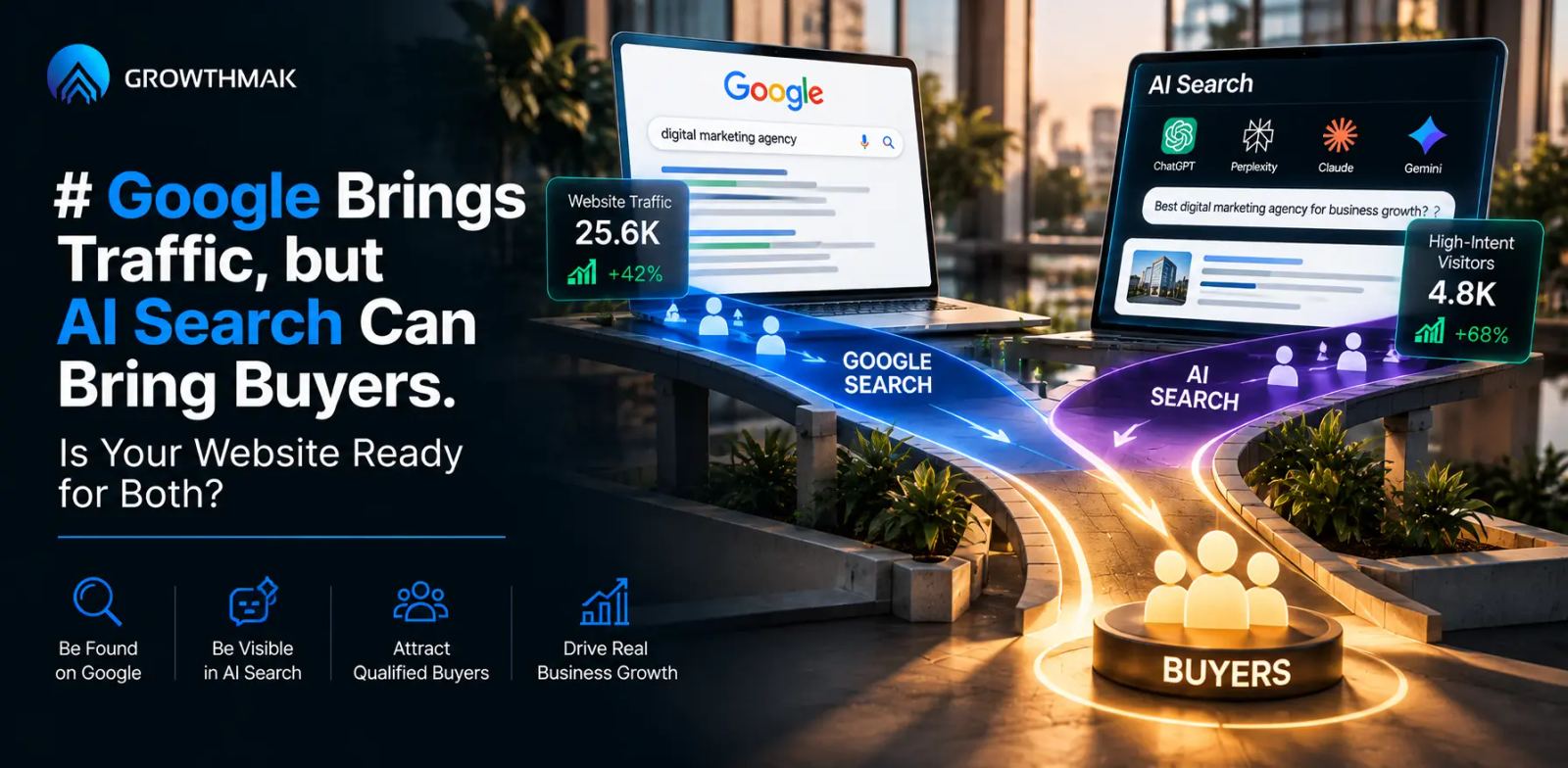
Google Brings Traffic, but AI Search Can Bring Buyers. Is Your Website Ready for Both?
Your main commercial page sits on the first screen of Google. The clicks are steady, the monthly report looks healthy, and the pipeline from search feels under control.
Then a buyer skips the search box entirely. They ask an AI assistant the same question your page answers, and it names three competitors while you never come up.
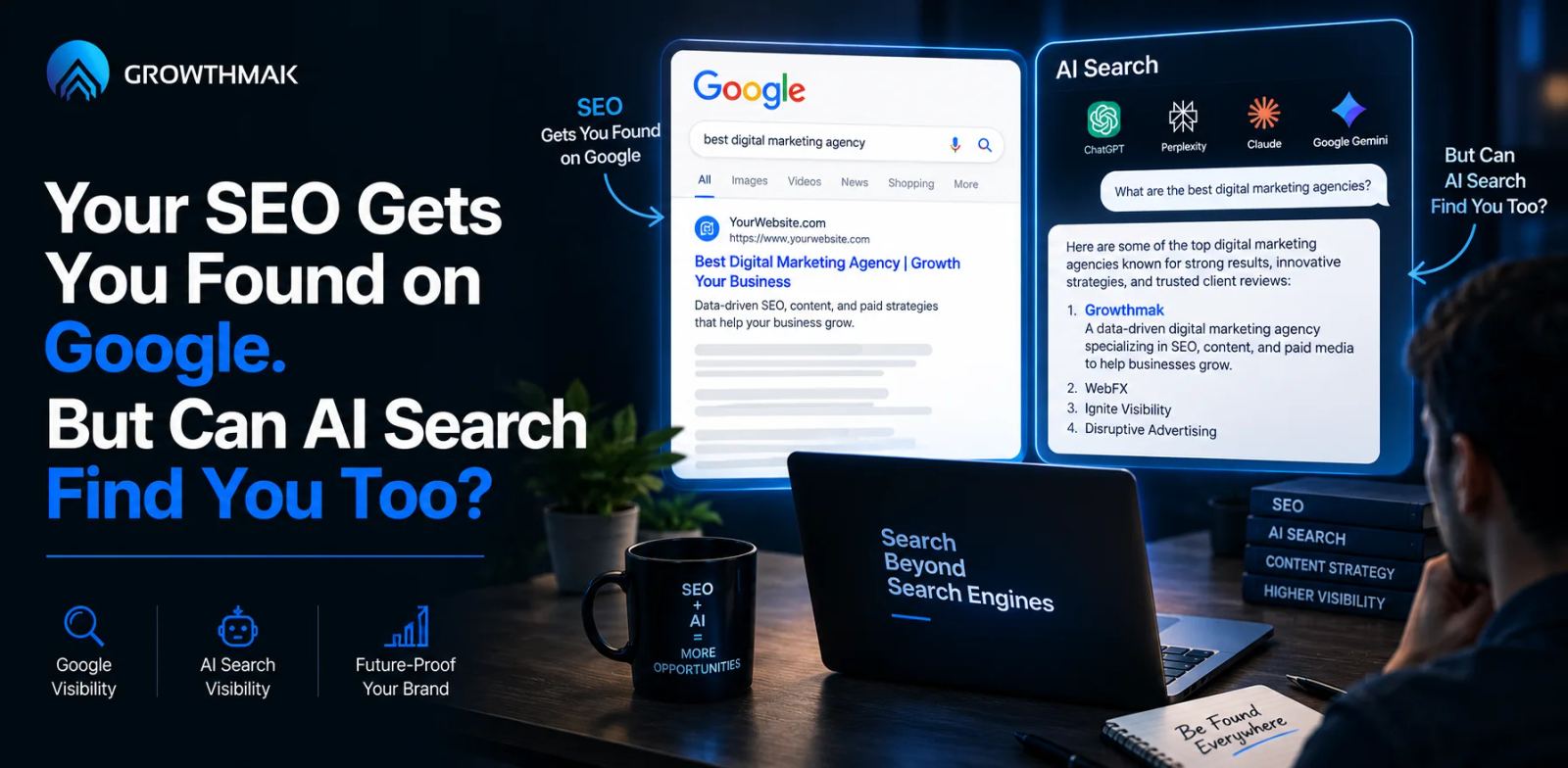
Both things are true at once, and that gap is what AI Search Optimization exists to close. Winning Google traffic and being chosen inside an AI answer are related jobs with different rules.
The reassuring part is that most of the work overlaps with what a well built site already needs. The costly part is the small set of changes that do not overlap, because they quietly decide who the buyer hears about.
Here is what actually separates traffic you can count from buyers you can win:
- How directly your page answers the question a buyer typed
- Whether a passage still makes sense pulled out of its page
- Whether anything on the page is specific enough to quote
- Whether the systems doing the reading can reach your content at all
Can Buyers Find You When They Ask an AI Instead of Google
Buyers can find you through AI tools only when your site is crawlable and your answers are easy to lift out, which is a different bar than ranking. Google rewards pages that earn authority and relevance over time. AI tools reward passages that are specific, self contained and consistent with other trusted sources. AI Search Optimization is the work of meeting that second bar without giving up the first, so the same page can win a Google click and a citation in the answer a buyer reads instead.
Two Channels, Two Jobs: Ranking Traffic and AI Search Traffic
A ranking system and a generative one solve different problems. Classic search engine optimization sorts candidates and hands the buyer a list to work through.
A generative answer does the working through for them. It picks a few sources, writes one response, and the buyer often acts on it without opening a single tab.
That difference changes what a good result even looks like. There is no position three inside a written paragraph, so you are either referenced or you are absent.
| Dimension | Google Ranking | AI Generated Answer |
|---|---|---|
| What it returns | An ordered list of links | One written answer, sometimes cited |
| What wins | Relevance, authority, links | Specific, extractable, consistent passages |
| Buyer behaviour | Clicks through to compare | Often acts without clicking |
| How you measure | Rank for a keyword | Whether you are named at all |
This is why strong rankings and weak AI search traffic sit together so often. The signals that lifted a page up a results list are not the signals that make one sentence quotable.
The practical takeaway is not to pick one channel. A buyer now moves between a Google list and an AI answer inside a single decision, often in the same afternoon, so a site that serves only one of them hands the other conversation to a competitor.
What AEO and GEO Actually Mean for a B2B Site
Answer Engine Optimization (AEO) means structuring content so a system can lift a direct answer straight from it. It grew out of the work teams once did for featured snippets.
Generative Engine Optimization (GEO) is the wider effort to be included and cited when a system writes an original answer rather than extracting one. The job shifts from owning the answer to being a source behind it.
Both sit on top of classic SEO rather than replacing it. The content still has to be reachable, credible and worth reading before either label matters.
In practice most teams doing AI SEO work end up doing both at once, because the changes that make a passage easy to extract also make it easy for a large language model to synthesize from.
Treat the labels loosely and the mechanics precisely. Whether a task belongs to AEO or GEO matters far less than whether a machine can read the page and find a clean answer on it.
For most B2B teams the useful mindset is to stop sorting tasks into buckets and ask one question of every page. Can a stranger, or a machine, read a single section and come away with a correct, quotable answer. If the answer is no, neither label will rescue it.
Where AI Search Optimization Fits Alongside Google
AI Search Optimization is not a second website or a parallel content program. It is a set of adjustments to how your existing pages are written and served.
It leans on the same crawlable foundation your rankings already depend on, then adds the structure that lets a single passage be quoted safely on its own.
It also changes what you are optimizing for. A ranked page is trying to earn a click, while a citable page is trying to earn a mention, and the second goal rewards clarity and restraint over persuasion and length.
The clearest way to see the overlap is to read our explanation of whether AI search can find your site at all, which covers the access problem that sits underneath everything here.
6 Changes That Build AI Search Visibility Without Losing Rankings
None of these ask you to abandon what ranks you today. They are edits to structure and delivery, not a fresh content budget.
Most of the gain sits in the first two, which cost only editing time. The rest range from a quick technical fix to the genuinely hard work of having something original to say.
| Change | Problem It Solves | Effort |
|---|---|---|
| Answer first, explain second | Answers buried too deep to quote | Low |
| Self-contained passages | Paragraphs that break when quoted alone | Low |
| Publish original specifics | No reason to cite you over anyone else | Medium |
| Fix crawler access | Content never read in the first place | Medium |
| Consistent facts sitewide | Ambiguity that lowers confidence | Low |
| Structured data where true | Relationships left for a machine to guess | Medium |
1. Answer the Buyer's Question in the First Two Sentences
Lead with the direct answer under a heading, then add the nuance and context below it.
Content that builds slowly toward a conclusion reads well and extracts badly. Content that states the conclusion and then defends it serves both the buyer and the machine.
A simple test helps here. Read only the first two sentences under each heading and ask whether they answer that heading on their own. If they do not, the section is not ready to be quoted.
This is the cheapest change on the list. It reorders sentences you already have rather than asking for new ones.
2. Write Passages That Stand on Their Own
Assume any paragraph might be read with no page around it for context.
That means repeating the subject rather than leaning on pronouns, and dropping openers that depend on the paragraph before them.
- Repeat the subject instead of writing this or it
- Avoid openers that reference an earlier section
- Keep one clear idea per paragraph, not three linked ones
3. Publish Specifics a Competitor Cannot Copy
A generic summary of a crowded topic gives a system no reason to prefer your version over everyone else saying the same thing.
Named processes, precise definitions, documented edge cases and real figures are what make a source worth reaching for. Distinctiveness is the strongest citation signal you control.
This is also the hardest item, and it is where a focused approach to ranking across AI search engines pays off, because it forces you to say something only you can say.
Original specifics also keep you relevant as more pages repeat the same summary. The more a topic gets covered everywhere, the more a system leans on the one source that adds a real number, a named method or a clearly stated exception.
4. Make Sure Crawlers Can Actually Read the Page
Content assembled entirely in the browser after load may never be read by a web crawler. If the text is not in the served HTML, treat it as invisible until proven otherwise.
Check it by viewing the page source rather than the rendered page. If your key answer is missing there, no amount of editing will help until the rendering changes.
The fix is rarely a rewrite. It is usually a change to how the page is built and delivered, so the words you already have arrive in the HTML a crawler can read on its next visit.
Sites with this issue usually need a website development team to change how pages render, not a new content plan.
5. Keep Your Facts Identical Across Every Page
Contradictions across your own pages lower confidence in all of them. Two founding years or three different service descriptions create the kind of ambiguity a system routes around.
Pick canonical wording for the facts that matter and use it everywhere, including the pages nobody thinks of as marketing.
The offenders are almost always the pages nobody revisits. A redesign refreshes the homepage and the core services while an old case study or a stale bio keeps stating the previous version of the truth.
6. Use Structured Data Only Where It Is True
Adding structured data makes relationships explicit that a machine would otherwise infer from prose. It supplements clear writing rather than standing in for it.
Only mark up what actually appears on the page. Markup describing content a visitor cannot see is a liability, not an advantage.
How to Measure AI Search Visibility When There Is No Rank
There is no rank position inside a generated paragraph, which makes classic reporting mostly useless here. Measurement has to change shape.
The workable approach is to query the tools directly with the questions your buyers ask, record whether you appear, and repeat it on a schedule.
- Keep a fixed list of buyer questions and check them monthly
- Record whether you are mentioned, cited, or absent
- Watch for referral traffic arriving from AI interfaces
This is coarser than rank tracking, and that is the current reality. Directional evidence gathered consistently still beats no measurement at all.
Treat the first month as a baseline rather than a verdict. The value shows up in the trend, as the same questions start naming you more often, or as referral visits from those tools climb over a quarter.
What AI Search Optimization Will Not Do
No technique guarantees a place in a specific answer. These systems are probabilistic, they change often, and two identical questions can produce different sources.
The useful way to hold this is as odds, not guarantees. Good AI Search Optimization raises the probability that you are the source a system reaches for, and lowers the chance a weaker competitor gets named in your place.
It also cannot substitute for having something worth citing. A system summarizing a topic reaches for sources that add something, not for another generic recap.
It does not replace classic SEO either, which is exactly why traditional SEO alone no longer works on its own. Crawlability, structure and subject authority still underpin every point above.
Final Thoughts
Google traffic and AI citation are two different wins, and treating them as one is why strong B2B sites go unnamed in the answers their buyers read.
That verdict flips the moment your site cannot be crawled properly. In that case, fix the technical access before touching a single sentence of content.
Ready to Win Both Channels? Explore Growthmak
Growthmak works with B2B companies whose expertise is real but whose websites are not yet built to be read by both Google and AI tools. The content is there; the structure and access often are not.
If the gap turns out to be technical structure or how pages are served, Growthmak can map where your site loses visibility across search and AI, then fix the foundation it stands on.
Frequently Asked Questions
AI Search Optimization makes your content easier for AI-powered search tools to discover, understand, and cite. It combines technical SEO, clear answers, credible information, and structured content to improve your brand’s visibility in AI-generated responses.
Yes, AI search visibility helps B2B companies reach potential buyers researching solutions and comparing providers. Although referral traffic may be lower than traditional search, relevant mentions and citations can strengthen brand credibility, influence purchasing decisions, and attract qualified prospects.
Answer Engine Optimization (AEO) helps content provide direct answers to user questions, while Generative Engine Optimization (GEO) improves the chances of being referenced in AI-generated responses. Both approaches prioritize clarity, credible information, structured content, and relevant expertise.
Yes, SEO for B2B companies remains essential because crawlability, technical accessibility, and topical authority help search systems discover reliable content. AI Search Optimization builds on these foundations, helping businesses improve their chances of earning relevant mentions and citations.
Google rankings do not guarantee AI citations because answer engines evaluate content differently. Buried answers, generic information, unclear passages, or inaccessible HTML can reduce citation potential. Improve visibility by publishing specific answers, demonstrating expertise, and maintaining technical accessibility.
Test five to ten questions your B2B buyers commonly ask across relevant AI search tools. Record brand mentions, source citations, and competitor visibility, then repeat monthly. Review AI referral traffic in analytics to identify patterns and measure progress.
AI-generated answers sometimes satisfy users without requiring website visits, potentially reducing clicks. However, citations can introduce your brand to qualified buyers, strengthen credibility, and influence purchasing decisions. Measure visibility alongside referral traffic, lead quality, and conversions for a balanced assessment.
No, most businesses can optimize the same content for AEO and GEO. Create clear, self-contained answers, use descriptive headings, include specific evidence, and maintain consistent facts. One authoritative page can support direct answers and AI-generated summaries.
AI Search Optimization timelines vary depending on crawling frequency, content quality, technical accessibility, and how AI platforms update their responses. Track brand mentions, citations, and referral traffic monthly to establish a baseline and identify meaningful improvements over time.
Written by Growthmak Team · B2B Growth Specialists
All blogs