Your SEO Gets You Found on Google. But Can AI Search Find You Too?
You hold position three for your main commercial term. The traffic is real, the rankings are stable, and the reporting looks healthy every month.
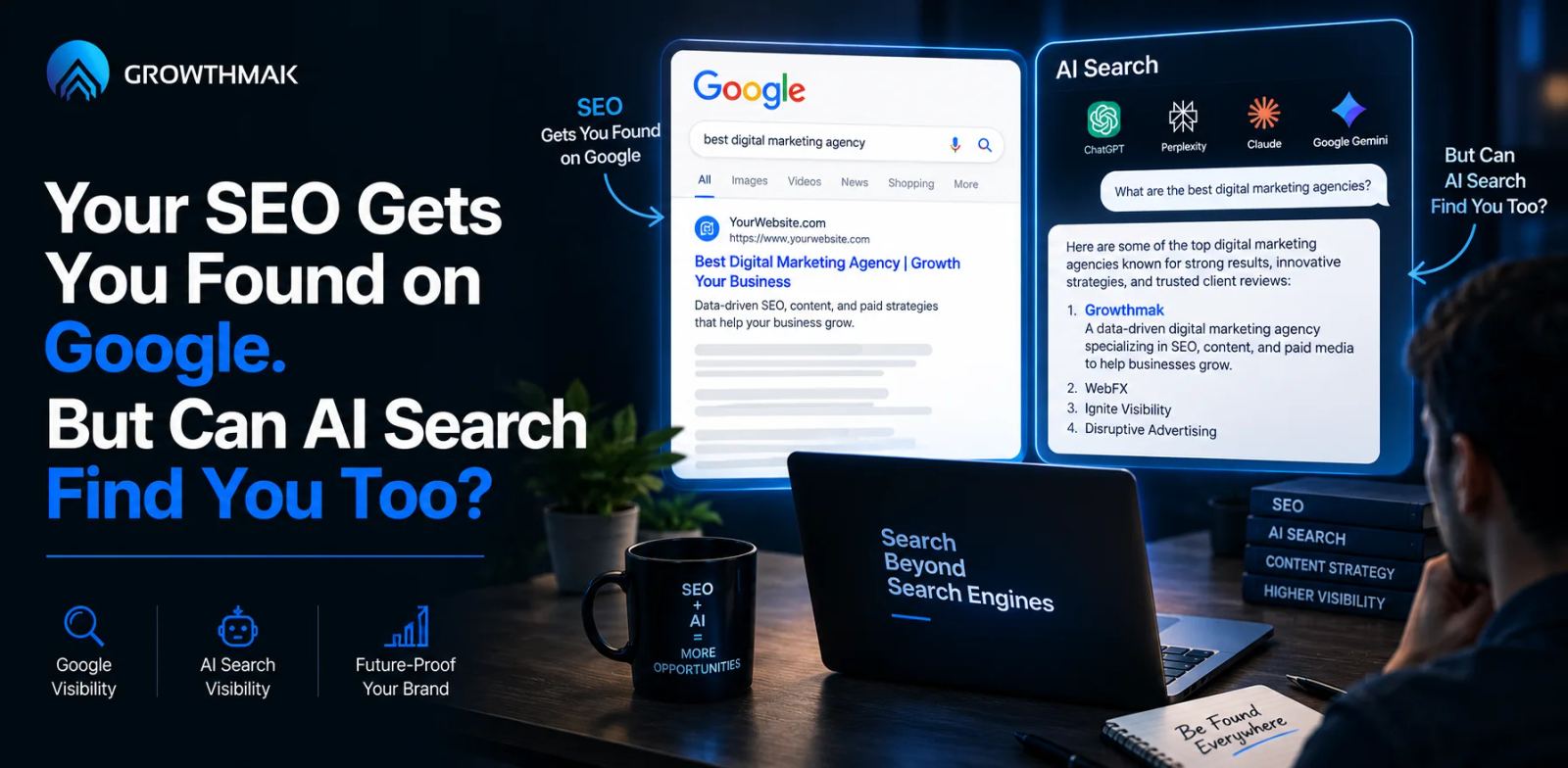
Then someone asks an AI assistant the same question your page answers, and three competitors get named while you do not appear at all.
That gap is what AI search optimization exists to close. Ranking well and being cited in a generated answer turn out to be two related but separate problems.
The good news is that most of the work overlaps with things a well-built site should already do. The bad news is that the parts which do not overlap are easy to miss entirely.
Here is what actually changes:
- How directly your page answers the question it targets
- Whether a passage makes sense pulled out of its page
- Whether anything on the page is specific enough to be worth quoting
- Whether the systems doing the reading can access your content at all
Can AI Search Find Your Website
AI systems can usually find your website if it is crawlable and publicly readable, but finding it is not the same as citing it. Ranking systems return a list of links and let the reader choose. Generative systems select a small number of passages and synthesize an answer, which means the winning content is whatever is easiest to extract, verify, and state cleanly. A page that ranks well through strong links and broad topical coverage can still be skipped if its actual answer is buried three sections down or written in a way that falls apart when quoted alone.
What AEO and GEO Actually Mean
Answer engine optimization, usually shortened to AEO, means structuring content so a system can lift a direct answer from it. It grew out of work on featured snippets and voice results, and it borrows heavily from research on question answering.
Generative engine optimization, or GEO, is the broader effort to be included and cited when a system writes an original answer rather than extracting one. The output is synthesized, so there is no single passage that wins.
AEO asks whether your sentence can become the answer. GEO asks whether your page becomes one of the sources behind an answer that nobody quoted directly.
Both sit alongside classic search engine optimization rather than replacing it. The underlying content still has to be discoverable, credible, and worth reading before either question becomes relevant.
In practice, most teams doing AI SEO work end up doing both at once, because the changes that make a passage extractable also make it easier to synthesize from.
The terminology is newer than the underlying idea. Publishers have been structuring content for machine extraction since featured snippets arrived, and AI search optimization extends that same instinct to a system that writes rather than quotes.
Treat the labels loosely and the mechanics precisely. Whether a given task belongs to AEO or GEO matters far less than whether a machine can read the page and find something worth using on it.
Why Ranking on Google Does Not Guarantee AI Visibility
A ranking system solves a different problem than a generative one. Ranking sorts candidates and hands the reader a list. Generation picks a handful of sources and produces prose.
| Dimension | Classic Search Ranking | AI Generated Answers |
|---|---|---|
| Output | An ordered list of links | A written answer, sometimes with citations |
| What wins | Relevance, authority, link signals | Extractable, specific, verifiable passages |
| Reader behavior | Clicks through to evaluate | Often accepts the answer without clicking |
| Measurement | Rank position for a keyword | Whether you are mentioned at all |
That last row is the uncomfortable one. There is no position three in a generated paragraph. You are either referenced or you are absent.
This is why strong rankings and weak AI search visibility can coexist. The signals that lifted a page up a results list are not the same signals that make a sentence worth quoting.
It also changes what a good outcome looks like. A page can lose clicks to an AI answer that cites it and still gain, if the citation reaches people who would never have scrolled to position three.
Businesses treating AI search optimization as purely defensive tend to miss that. The realistic goal is being the source behind the answer, not preventing the answer from existing.
How AI Systems Choose What to Cite
Most systems answering questions about current information use some form of retrieval augmented generation, which retrieves candidate passages first and generates an answer from them second.
That two-stage process matters enormously. If your passage never gets retrieved, nothing about its quality affects the final answer, because the generation step never sees it.
Retrieval favors passages that are topically tight and self-contained. A paragraph that only makes sense after reading the two before it is a weaker retrieval candidate than one that stands alone.
Consistency across multiple sources also matters. When several independent pages state the same specific fact, a system has more reason to treat that fact as reliable and repeat it.
None of this is fully observable from outside. These systems change frequently and rarely publish their selection criteria, so the honest position is that we are working from reasonable inference rather than documented rules.
What that means practically is favoring changes that would help regardless. Clearer answers, cleaner structure, and better technical accessibility pay off across every system, including whichever ones arrive next.
6 Changes That Improve AI Search Visibility
None of these require abandoning existing work. They are adjustments to how content is structured and served, not a separate content program.
Most of the effort in AI search optimization sits in the first two items, which cost nothing beyond editing time. The remaining four range from a technical fix to a genuine content investment.
1. Answer the Question Before Explaining It
Lead with the direct answer in the first two sentences under a heading, then add nuance, caveats, and context underneath.
Content that builds toward a conclusion is satisfying to read and difficult to extract. Content that states the conclusion and then justifies it serves both audiences at once.
This is the single cheapest change on the list. It requires reordering existing sentences rather than writing anything new, and it improves the page for impatient human readers at the same time.
2. Write Self-Contained Passages
Assume any given paragraph might be read entirely on its own, with no surrounding page for context.
That means repeating the subject rather than leaning on pronouns, and avoiding openers that depend on the previous section to make sense.
This reads slightly more repetitive to a human than polished prose would. That trade is usually worth making, because a paragraph that survives being lifted out of context is worth more than one that flows perfectly but breaks when quoted.
- Repeat the subject instead of writing this or it
- Avoid openers that reference an earlier paragraph
- Keep one clear idea per paragraph rather than three linked ones
3. Publish Specifics Nobody Else Has
A generic summary of a well-covered topic gives a system no reason to prefer your version over the forty others saying the same thing.
Specific numbers, documented processes, edge cases, and precise definitions are what make a source worth reaching for. Distinctiveness is the strongest citation signal available.
- Original data or figures nobody else has published
- Documented process detail rather than a general overview
- Precise definitions and clearly stated exceptions
This is also the hardest item on the list, because it requires having something to say rather than restructuring what is already written.
4. Make Sure Crawlers Can Reach the Page
Content assembled entirely in the browser after load may never be read by a web crawler. If the text is not in the served HTML, treat it as invisible until proven otherwise.
This is a technical problem rather than a writing problem, and it is the single most common reason a genuinely good page gets no AI visibility at all.
Check it by viewing the page source rather than the rendered page. If your key text does not appear there, no amount of editing will help until the rendering changes.
Sites with this issue usually need a website development team to change how pages are rendered, not a new content plan.
5. Keep Your Facts Consistent Everywhere
Contradictory details across your own pages lower confidence in all of them. Two different founding years or three different service descriptions create ambiguity a system will route around.
Pick canonical wording for the facts that matter and use it consistently across the site, including in places nobody thinks of as marketing pages.
Footers, author bios, and old landing pages are the usual offenders here. They rarely get reviewed during a redesign and they end up contradicting the current version of the site far more often than anyone expects.
6. Use Structured Data Where It Genuinely Applies
Adding structured data makes relationships explicit that a machine would otherwise have to infer from prose. It supplements clear writing rather than substituting for it.
Only mark up what actually appears on the page itself. Markup describing content that a reader cannot actually see is a liability rather than an advantage, and it can undermine trust in the rest of the page.
| Change | Problem It Solves | Difficulty |
|---|---|---|
| Answer first, explain second | Answers buried too deep to extract | Low |
| Self-contained passages | Paragraphs that break when quoted alone | Low |
| Publish original specifics | No reason to cite you over anyone else | Medium |
| Fix crawler accessibility | Content never read in the first place | Medium |
| Consistent facts sitewide | Ambiguity that lowers confidence | Low |
| Structured data where relevant | Relationships left implicit | Medium |
How to Measure AI Search Visibility Without Rankings
There is no rank position inside a generated paragraph, which makes classic reporting largely useless here. Measurement has to change shape.
The practical approach is to query the tools directly with the questions your customers ask, record whether you appear, and repeat that on a schedule.
- Keep a fixed list of questions and check them monthly
- Record whether you are mentioned, cited, or absent entirely
- Watch for referral traffic arriving from AI interfaces
This is coarser than rank tracking and that is simply the current reality. Directional evidence gathered consistently still beats no measurement at all.
Set expectations accordingly before anyone builds a dashboard around it. AI search optimization does not yet produce the clean week-over-week reporting that classic search has trained everyone to expect.
What AI Search Optimization Cannot Do
No technique guarantees inclusion in a specific answer. These systems are probabilistic, they change frequently, and two identical questions can produce different sources.
It also cannot substitute for having something worth citing. A large language model summarizing a topic will reach for sources that add something, not for another restatement of the consensus.
It does not replace classic search engine optimization either. Crawlability, site structure, and genuine subject authority still underpin everything discussed here.
Anyone selling AI search optimization as a guaranteed placement is describing something these systems do not offer. What the work reliably does is improve the odds and remove the technical reasons for exclusion.
Final Thoughts
Ranking and citation are related problems with different mechanics, and treating them as identical is why strong sites go unmentioned in AI answers.
That verdict flips when the site itself cannot be crawled properly. In that case, fix the technical accessibility before touching a single sentence of content.
Ready to Improve AI Search Visibility? Explore Growthmak
Growthmak works with businesses whose content is genuinely valuable but whose websites may not be structured in a way that makes their information easy for search engines and AI systems to understand, retrieve, and surface.
If the problem turns out to be technical structure, accessibility, or how content is presented to search engines and AI systems, Growthmak's SEO services can address the underlying issues as part of a broader search visibility strategy.
Book a 30-minute growth call with Growthmak, or get a growth audit for your website, to identify where your site may be losing visibility across Google and AI search.
Frequently Asked Questions
AI search optimization makes content findable, extractable and citable by systems that answer questions directly instead of returning links. It overlaps with classic SEO but targets citation rather than rank position, covering both content structure and technical accessibility.
Answer engine optimization structures content so a direct answer can be extracted cleanly. Generative engine optimization targets being cited when a system writes an original answer. The distinction is conceptual; the practical work overlaps almost entirely.
Yes. Most systems generating answers still draw on crawled web content, so crawlability, site structure and subject authority remain foundational. AI SEO supplements that foundation rather than replacing it, and skipping it weakens everything built on top.
Ranking and citation use different selection logic. Pages often rank well through accumulated authority while remaining poor citation candidates, usually because the actual answer sits several sections down or because individual paragraphs stop making sense when quoted alone.
It helps by making relationships explicit that a machine would otherwise infer from prose, reducing ambiguity. It cannot compensate for unclear writing or generic content. Only mark up what genuinely appears on the page itself.
Keep a fixed list of questions customers actually ask, query AI tools on a schedule, and record whether you were mentioned, cited or absent. Watch for referral traffic too. Measurement here is coarser than rank tracking.
Blocking removes any possibility of citation, so it is a trade-off rather than pure protection. Publishers dependent on page visits often block; businesses using content for awareness usually should not. It is a commercial decision.
Timelines depend on recrawl cycles and model behaviour, so they are less predictable than ranking changes. Technical fixes register soonest. Content restructuring takes longer. Expect directional movement across weeks, and treat single checks as snapshots.
Usually not. Content that answers questions directly, using self-contained paragraphs and specific detail, serves extraction and synthesis simultaneously. Producing duplicate versions creates maintenance overhead and risks exactly the inconsistency that undermines confidence in your facts.
Written by Growthmak Team · B2B Growth Specialists
All blogs