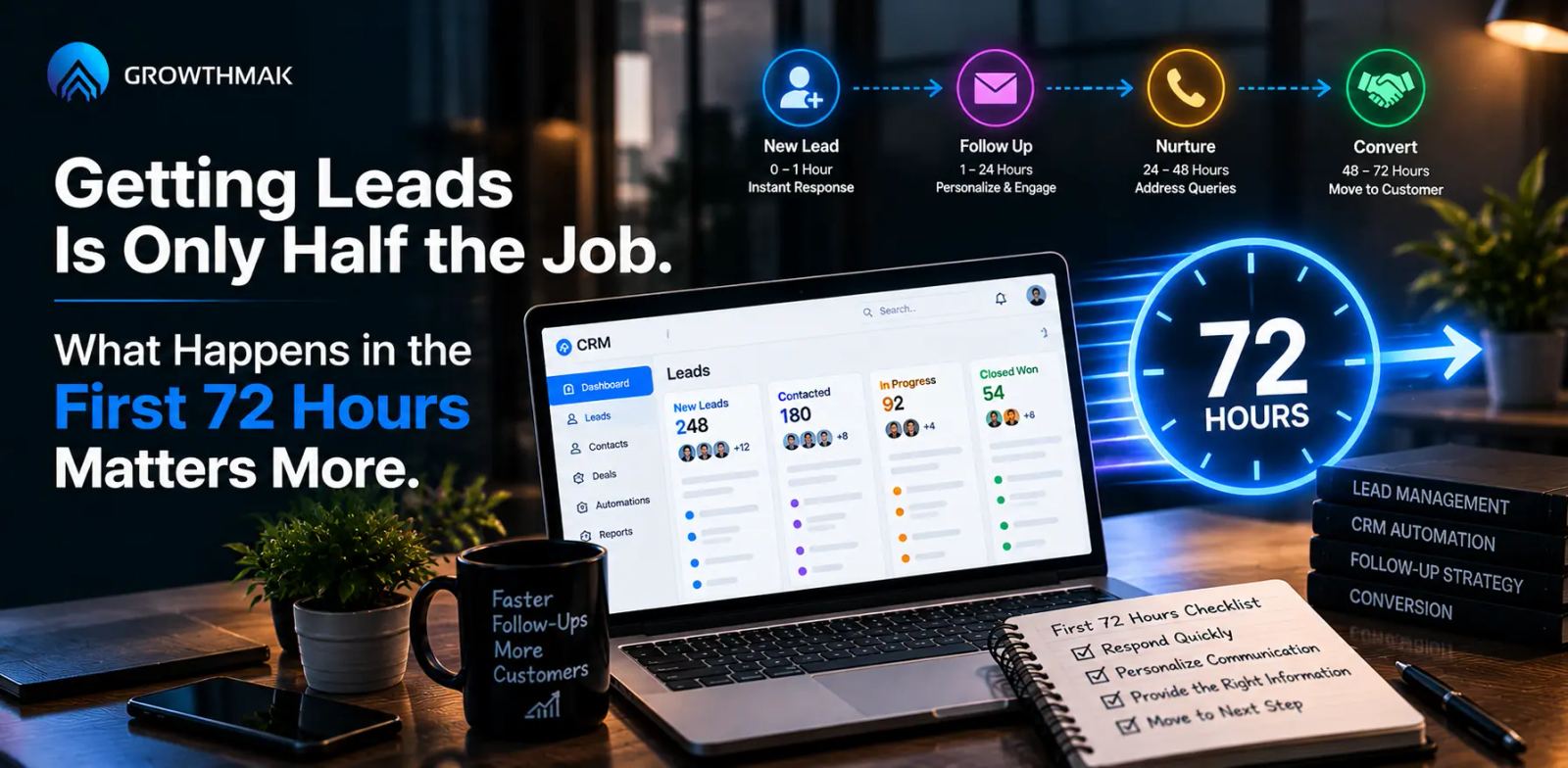
Getting Leads Is Only Half the Job. What Happens in the First 72 Hours Matters More.
A strong lead fills in your form on a Tuesday morning. They have a budget, a real problem, and they just raised their hand to the market.
Nobody calls until Thursday afternoon. By then they have spoken to two competitors, booked a demo with one, and your email lands in a decision that is already half made.
The lead was never the problem. The gap between the inquiry and the first real conversation is where the deal quietly slipped away, and a lead follow-up strategy is what closes it.
It is an uncomfortable place to lose money, because nothing on the dashboard flags it. Traffic looks fine, lead volume looks fine, and the only symptom is a close rate that never matches the quality of the inquiries coming in.
Here is what actually decides whether that inquiry becomes a meeting:
- How quickly someone responds to the first signal of interest
- Whether one named person owns the lead or it floats
- Whether the follow-up is a planned sequence or a single call
- Whether the message fits where the buyer actually is
Why the First 72 Hours Decide Whether a Lead Converts
The first 72 hours decide most inbound outcomes because buyer intent is highest the moment a lead raises a hand and fades fast afterward. A lead follow-up strategy protects that window by fixing four things: how quickly the first touch goes out, who owns the lead, how many times you reach out, and what you say at each stage. Teams that respond in minutes with a clear owner and a planned cadence convert far more of the same inquiries than teams relying on whoever happens to see the notification first.
Getting the Lead Was the Easy Part
You already spent money and effort to earn the inquiry. Every channel feeding your pipeline, from ads to lead generation, exists to produce that single raised hand.
So it is strange how often the money stops working the instant the form is submitted. The lead sits in an inbox, a notification scrolls past, and the investment leaks out the back.
Most teams respond by chasing more traffic. The faster fix is usually to handle the leads you already win, which is where leads that arrive cheap but never close exposes the real gap.
Think about the math for a moment. If you win the same number of leads but contact twice as many of them in time, your pipeline grows without a single extra dollar of spend. That is why the handling side is usually the cheaper place to find growth.
What a Lead Follow-Up Strategy Actually Covers
A lead follow-up strategy is not a reminder to try harder. It is a defined process covering four things: speed, ownership, cadence and message.
Speed is how fast the first touch goes out. Ownership is who is responsible. Cadence is the planned sequence of contacts. Message is what you say at each step.
Each of the four fails in a different, recognizable way. Speed fails as a lead contacted days late. Ownership fails as a lead no one claimed. Cadence fails as a single ignored call. Message fails as a pitch aimed at the wrong moment.
The simplest way to see it is as a map of the first 72 hours, with a known action for each stage rather than a guess.
| Window | What usually happens | What a strategy does |
|---|---|---|
| First hour | The lead waits in an inbox | A fast first reply while intent is high |
| First day | A single missed call | A second channel and a booked time |
| Day two | Silence | A value touch and a clear next step |
| Day three | The lead is forgotten | A final attempt before nurture begins |
The point of the map is consistency. Every lead gets the same disciplined handling instead of depending on how busy the team was that morning.
It also gives a manager something to inspect. When the process is written down, you can see which stage breaks, coach to it, and hold the standard, rather than blaming individual reps for an outcome the system allowed.
A lead follow-up strategy earns its name by being written down and followed, not improvised in the moment. The teams that treat a lead follow-up strategy as a living process, reviewed and adjusted, pull steadily ahead of those relying on good intentions and a busy calendar.
The 6 Moves That Turn Inbound Into Booked Meetings
None of these require a bigger team. They are process changes that make the people you have convert more of the leads you already pay for.
The first two carry most of the gain and cost almost nothing. The rest range from a scheduling change to a reporting habit.
Order matters less than completeness. A team that nails speed but never measures will plateau, and a team that measures beautifully but responds slowly will have precise reports on exactly why it keeps losing.
| Move | Problem It Solves | Effort |
|---|---|---|
| Respond fast | Intent fading before the first touch | Low |
| One owner per lead | Leads that float and get dropped | Low |
| Multi-touch cadence | One call then giving up too soon | Medium |
| Stage-matched message | Pitching a buyer who is not ready | Medium |
| Automate reminders | A busy week breaking the cadence | Medium |
| Measure the funnel | No idea where leads actually die | Low |
1. Respond While Intent Is Still Hot
Speed to lead beats polish on the first touch. A fast, human reply while the buyer is still thinking about you outperforms a perfect message that lands two days later.
The first company to start a real conversation usually frames the rest of it. Everyone who follows is compared to the one who answered first.
You do not need a scripted monologue. You need to reach the person while your brand is still the one on their mind.
There is a human reason this works too. A buyer who gets a quick, relevant reply reads it as a sign you will be easy to deal with later, and that impression carries into every conversation that follows.
2. Give Every Lead a Single Owner
Lead management breaks down when everyone can see a lead and no one is responsible for it. Shared inboxes are where good inquiries go to be admired and never actioned.
Assign each inquiry to one named person the moment it arrives. Ownership removes the quiet assumption that someone else already picked it up.
A clear owner also makes the customer relationship management record useful, because there is one person accountable for keeping it current.
Ownership also fixes accountability after the fact. When a lead goes cold, you can see who held it and why it stalled, which turns a lost deal into a lesson instead of a mystery nobody can explain.
3. Run a Multi-Touch Cadence, Not One Call
One attempt and a shrug loses most of the leads you could have reached. People are busy, miss calls, and forget the form they filled in an hour ago.
A planned cadence of calls, emails and messages across the window recovers a large share of those. The contacts are scheduled, not left to memory.
- Decide how many touches, on which channels, across the 72 hours
- Vary the channel so you are not just calling an unanswered phone
- Stop when the lead replies or clearly asks you to
Persistence has a reputation problem it does not deserve. Done with useful, varied touches rather than the same voicemail five times, a cadence reads as attentive rather than pushy, and most buyers quietly respect it.
4. Match the Message to the B2B Sales Process Stage
A fresh inquiry is rarely ready for a hard close. Pushing a contract at someone still scoping the problem reads as tone deaf, and good sales process engineering avoids it.
Meet the buyer where they are. An early lead needs a reason to talk; a late one needs a clear path to decide. The right next step depends on the stage, not the script.
Getting this consistent is also how you bridge the gap between marketing and sales, so a lead never falls into the gap where marketing thinks sales has it and sales thinks it is still a marketing lead.
This is also where many teams lose trust. A buyer still framing the problem does not want pricing pressure, and a buyer ready to decide does not want another introductory explainer. Reading the stage correctly is most of the skill.
5. Automate the Reminders, Not the Relationship
Let the system do the mechanical work. Marketing automation and your CRM can trigger the first alert, route the lead to its owner, schedule the cadence and log every touch.
Keep the judgement human. Automation decides when to remind someone to reach out, not what to say when a real person picks up.
Done well, this is where CRM automation catches the follow-ups a team forgets, so a single busy afternoon no longer quietly breaks the whole process.
The test is simple. If a task would happen the same way every time regardless of who the lead is, automate it. If it depends on what the person actually said or needs, leave it to a human.
6. Measure Lead Response Time and Sales Lead Conversion
You cannot fix what you do not measure. Track lead response time, meaning how long the first touch takes, and watch it as closely as you watch lead volume.
Then track sales lead conversion through the funnel: how many inquiries become conversations, how many conversations become meetings, and how many meetings become deals.
The numbers turn a vague feeling that leads are slipping into a specific stage you can fix. That is the difference between a hunch and a process.
Set a small number of numbers you check every week. A short, consistent scoreboard beats an elaborate report nobody opens, and it keeps the whole team pointed at the stage that needs attention most.
What a Follow-Up Strategy Will Not Fix
A follow-up strategy will not turn genuinely unqualified leads into customers. If the fit is wrong, faster contact only reaches a no sooner, which is still useful but not a sale.
It also cannot replace a real offer. No cadence rescues a weak value proposition or a product the market does not want.
And it cannot run on data you do not capture. If inquiries are not logged with a source, an owner and a timestamp, the whole process is guesswork.
It also will not fix a mismatch between the leads you attract and the customers you want. If the top of the funnel pulls in the wrong profile, better follow-up just converts more of the wrong people, so that fix sits further upstream.
Final Thoughts
The handling gap costs more than the traffic gap, and treating lead volume as the only lever is why strong pipelines still leak qualified buyers.
That verdict flips when follow-up is slow and ownerless. Fix the speed and the ownership first, because no clever message helps a lead nobody contacted in time.
None of this needs new tools before it needs new habits. Most teams already own a CRM that could route and remind; the missing piece is usually the agreement on speed, ownership and cadence that makes the tool earn its cost.
Ready to Stop Losing Leads After the Click? Explore Growthmak
Growthmak works with B2B teams that generate real inquiries but lose too many of them in the hours after the form. The traffic works; the handoff does not yet.
If the leak turns out to sit between the lead and the first conversation, Growthmak can map where inquiries die and build the routing, cadence and reporting that protect them.
The work is rarely glamorous, but it is reliable. Closing the gap between a lead and a conversation tends to lift results faster than any new campaign, because you are converting demand you have already paid to create.
Frequently Asked Questions
A lead follow-up strategy defines how businesses respond to new inquiries, assign ownership, schedule outreach, and communicate with potential customers. A structured process ensures every lead receives timely attention, consistent communication, and appropriate next steps throughout the buying journey.
Speed to lead matters because buyer interest can decline while prospects wait for a response. Timely, relevant communication helps businesses start conversations earlier, build trust, and engage potential customers before competitors influence their purchasing decisions.
B2B companies should respond to new leads as quickly as their teams can consistently manage, ideally within minutes when practical. Clear response targets, instant notifications, and assigned ownership help sales teams engage prospects while their interest remains high.
Follow up several times using a planned combination of calls, emails, and relevant messages across the first few days. Adjust the cadence to your audience, stop when prospects decline further contact, and nurture unresponsive leads appropriately.
Lead management involves capturing inquiries, assigning ownership, and ensuring timely action, whereas lead nurturing builds relationships with prospects who are not ready to purchase. Effective follow-up combines both approaches to address immediate opportunities and develop future customers.
Yes, automate repetitive tasks such as lead routing, reminders, notifications, and activity tracking to maintain consistency. However, keep conversations personalized, allowing sales representatives to understand buyer needs, address specific concerns, and build meaningful relationships throughout the decision-making process.
Measure sales lead conversion by tracking inquiries, qualified conversations, booked meetings, and closed deals across each funnel stage. Combine conversion rates with response times and follow-up activity to identify bottlenecks, improve sales performance, and increase revenue opportunities.
Marketing and sales should agree on lead qualification criteria, handoff procedures, and response expectations before inquiries arrive. Assigning every lead to one accountable owner prevents missed opportunities, reduces internal confusion, and ensures prospects receive timely communication.
Good leads often go cold because of delayed responses, unclear ownership, inconsistent follow-ups, or generic communication. Improving response speed, establishing accountability, and maintaining a structured outreach cadence helps businesses recover opportunities without continually increasing their marketing spend.
Written by Growthmak Team · B2B Growth Specialists
All blogs