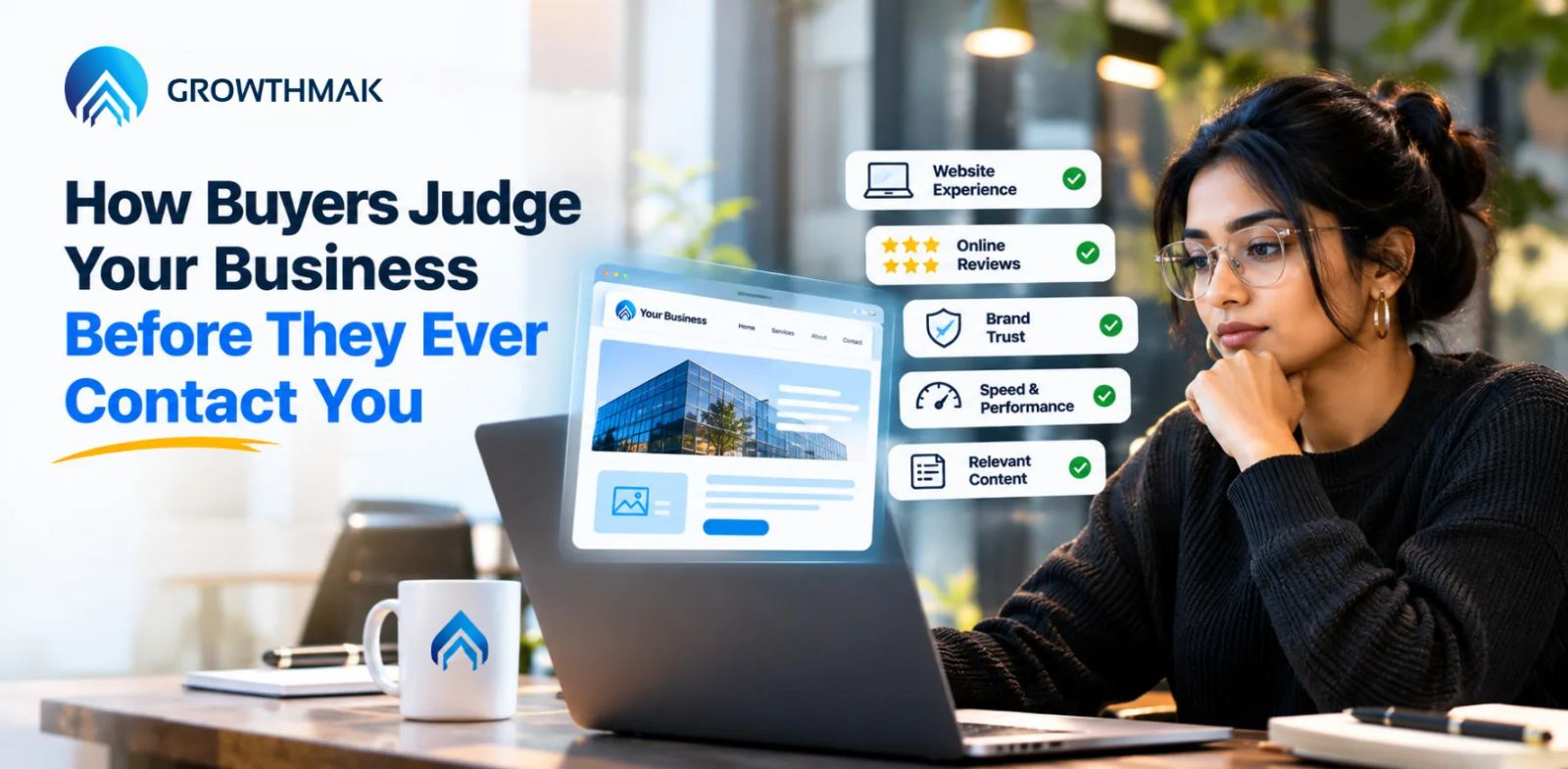
How Buyers Judge Your Business Before They Ever Contact You
A prospect lands on your website late one evening. They read two pages, check your reviews, look up your founder on LinkedIn and ask an AI tool what it knows about you. Then they close the tab.
Three weeks later they sign with a competitor. Your CRM never knew they existed.
That is how the B2B buyer journey works now. Most of the judging happens in silence, long before anyone fills in a form or books a call.
You cannot attend those private research sessions. You can decide what buyers find when they run them. This guide shows you:
- What the latest buyer research says about the silent shortlist
- How buyers research vendors, in the order they usually do it
- Which trust signals on website pages carry the most weight
- How to build reviews and case studies that persuade a whole buying group
- Where the legal lines sit for reviews and testimonials
How Does the B2B Buyer Journey Work Today?
Today's B2B buyer journey is mostly self-directed. A buying group researches the problem, explores solutions and builds a shortlist on its own, using your website, case studies, independent reviews, team profiles, peer advice and AI tools. By the time it contacts sales, it usually has a favourite vendor and firm requirements. So the deal is often won or lost before the first conversation. Your job is to make sure that, at every point of that private research, buyers find clear answers and credible proof that point to you.
The Numbers Behind the Silent Shortlist
The 2026 Global B2B Buyer Experience Report from 6sense, based on 4,611 recent B2B buyers, puts hard numbers on the shift. Buyers chose the vendor they favoured before contacting a seller 82% of the time.
Being left out early is close to fatal. Vendors missing from the initial shortlist had less than a 10% chance of winning. Buyers also spent roughly 60% of the average 10.3-month buying cycle in the selection phase before contacting a seller.
The same research firm's 2024 report found the average buying group had 11 people, and 85% of buyers had set their purchase requirements before reaching out. That group is what the buying center model describes: several roles, each with its own concerns.
Two practical conclusions follow for anyone managing a B2B buyer journey. First, the job of marketing is to earn a place on the day-one shortlist, not just to generate form fills. Second, your best proof must be findable without a form, a call or a sales deck.
How Buyers Research Vendors: The Five Checks
Every buyer decision process involves research and evaluation. In B2B, that research follows a fairly predictable pattern. Here is how buyers research vendors, and the stage each check usually belongs to.
| Journey stage | What the buyer is asking | Trust signal that answers it |
|---|---|---|
| Problem research | Is this problem common, and what causes it? | Educational content with a clear point of view |
| Solution exploration | What kind of solution fits a company like ours? | Service pages that name the buyer, the problem and the outcome |
| Vendor shortlisting | Who has solved this for businesses like ours? | Industry-matched case studies and client logos |
| Validation | Will this vendor deliver what it claims? | Independent reviews, named testimonials, visible team |
| Selection | Is this a safe decision I can defend internally? | Clear process, timelines, scope and references |
1. The Website Test: Do You Solve My Problem?
Buyers decide in seconds whether your site is relevant. If the homepage talks about passion and partnership instead of the problem you solve and who you solve it for, they move on.
Your homepage should answer three questions within the first screen:
- What do you do, in plain words a buyer would use?
- Who is it for, by industry, size or role?
- What should I do next if this sounds like my problem?
Weak homepages are usually a symptom of unclear positioning. We explain why many companies have a positioning problem, not a lead problem, and cover the real reasons visitors leave without contacting you.
2. The Proof Test: Who Else Trusts You?
Next, buyers look for evidence that companies like theirs already trust you. They want a case in their industry, at their size, with a problem they recognise.
Client logos help when you have permission to use them, but detail persuades more than a logo wall. Browse our Growthmak case studies to see how we structure proof by industry and market.
3. The Peer Test: What Do Customers Say?
Buyers trust other buyers more than vendors. Independent customer reviews carry weight because you do not control them, which is exactly why they work as social proof.
Recency and detail matter. A steady flow of specific reviews beats a pile of old five-star ratings. That is why review generation services work best as a routine built into delivery, not a one-off campaign.
Ask for reviews on the platforms your buyers actually use, not only the easiest one to set up. A strong profile on the wrong site helps nobody in your market.
4. The People Test: Who Would I Work With?
B2B buyers are hiring people, not just a company. They check who leads the business, who would run the account and whether those people have a visible point of view.
A real team page, active founder profiles and consistent B2B brand storytelling answer that question before a buyer has to ask it.
Point of view is the part most firms skip. Short posts, talks or articles that take a clear stance on your buyers' problems show expertise far better than a list of services.
5. The AI Test: What Do Answer Engines Say About You?
This check is the newest and the fastest growing. In the same 2026 report, 81% of buyers said they use a large language model during evaluations, and 21% said such tools shaped their view of vendors before contacting a seller.
When you check, look for three things: whether your business is named for category questions, whether the description of your services is accurate, and which sources the answer cites. Those sources show you where your reputation is being formed.
If an AI tool describes your business inaccurately, or not at all, you lose ground you never see. Start by checking whether AI search can find you.
Where the Silent Research Actually Happens
Your website is only one stop. Buyers piece together a view of you from several places, many of which your analytics will never record:
- Search engines, for category, problem and comparison queries
- Review platforms and directories in your industry
- LinkedIn, where they check your company page, founders and team
- Peer communities, private groups and conversations with colleagues
- AI tools, where they ask for shortlists, comparisons and summaries
Because so much of this is invisible, add a simple optional field to your forms: how did you first hear about us? The answers will often surprise you, and they tell you which of these channels deserves more attention.
Trust Signals on Website Pages That Buyers Actually Check
Most sites have trust signals. Few have strong ones. The difference is specificity, and the table below shows what that looks like.
| Signal | Weak version | Strong version |
|---|---|---|
| Case study | A logo and a paragraph of praise | Industry, problem, approach and client-approved results |
| Testimonial | Great team, highly recommend, anonymous | Named person, role, company and the specific outcome |
| Team page | Stock photos or no team page at all | Real people, roles and links to professional profiles |
| Process | We tailor everything to you | Named steps, typical timelines and what the client receives |
| Credentials | Award badges with no context | Partner certifications and recognitions linked to the issuer |
| Contact | A single form buried in the footer | Clear contact options and a stated response time |
Pick the weakest row on your own site and fix that first. One strong signal does more than five generic ones.
Placement matters as much as quality. Put proof next to the decision it supports: a relevant case study on each service page, a short testimonial beside the contact form, and credentials near pricing or process details. A testimonials page on its own is easy to miss.
Social Proof Marketing for a Buying Group
Consumer brands win with volume: thousands of ratings and a star average. B2B social proof works differently, because you are persuading a committee, and each member asks a different question.
Effective social proof marketing maps proof to those roles:
- Finance: evidence of return, cost control and predictable delivery
- Technical teams: proof of reliability, security and clean integration
- Day-to-day users: reviews about responsiveness and ease of working together
- Leadership: peers in their industry who took the same decision and stand by it
Format matters too. A short video of a client explaining a result in their own words is hard to fake, and it gives every member of the buying group something easy to share internally.
Mapping the journey for each role makes these gaps visible. Our guide to B2B customer journey mapping walks through the method.
What Makes B2B Case Study Examples Persuasive
The best B2B case study examples read like the buyer's own situation. They follow a simple structure that makes the result believable:
- Situation: who the client is, the industry and the market
- Constraint: what made the problem hard, such as budget, timing or legacy systems
- Decision: what was done, and why that path was chosen over others
- Result: outcomes the client has approved for publication
- Verification: a named quote or reference that confirms the story
Never inflate a number to make a case look stronger. Buyers check, and one exaggeration undoes every other claim on the page. Pair each case with matching client testimonials where you can.
Then use each case more than once. Link it from the matching service page, attach it to proposals and send it in sales follow-ups, so the proof reaches buyers at the moment they are weighing a decision.
How to Measure Influence You Cannot See
You will never track every step of private research, but you can see its effects. Watch these signals each month:
- Answers to the how did you hear about us field
- Growth in branded search and direct visits to your site
- Views and new reviews on your review platform profiles
- Sales call notes on who else the buyer considered and why
- How AI tools describe and rank you for category prompts
If these trend up while your trust signals improve, your proof is doing its job before the first call.
How to Build Reviews Without Breaking the Rules
Review rules have tightened in your key markets. In the United States, 16 CFR Part 465 prohibits fake reviews and testimonials, undisclosed insider reviews and review suppression, and the FTC can seek civil penalties against knowing violators.
The UK banned fake reviews from 6 April 2025, and businesses are expected to take reasonable steps to stop fake reviews appearing on their sites. Wherever you sell, the safe approach is the same:
- Ask genuine customers, ideally right after a milestone they value
- Never pay for positive reviews or offer rewards only for good ones
- Disclose any relationship between the reviewer and your business
- Respond to criticism publicly and calmly instead of trying to remove it
Honest testimonials collected this way are also more persuasive, because they sound like real people.
What Social Proof Cannot Do
Proof amplifies what is already there. It cannot rescue a poor fit, slow delivery or a vague offer, and buyers who feel misled will say so in public.
A few critical reviews are not a disaster either. A thoughtful public response can show a buyer more about how you handle problems than any testimonial.
Final Thoughts on the B2B Buyer Journey
The B2B buyer journey is decided mostly before contact, so the vendors who win are the ones buyers find, understand and trust during private research.
The condition that changes everything is whether you show up early. If you are missing from that first shortlist, the rest of your sales process rarely gets a chance to work.
This week, research your own business the way a buyer would. Read your homepage cold, open your case studies, check your reviews, look at your team page and ask two AI tools about you. Fix the weakest answer first.
See What Buyers Find When They Research You
The Growthmak Social Proof Layer covers the reviews, ratings, case studies and credibility signals buyers check before they ever reach out. We benchmark your trust signals against competitors and rank the fixes by impact.
Start with a free 30-minute diagnostic and receive a written plan within one day. Book your free Growthmak diagnostic and see your business the way your next buyer will.
Frequently Asked Questions
The B2B buyer journey is the path a buying group follows from recognising a problem to choosing a supplier. It usually runs through problem research, solution exploration, vendor shortlisting, validation and selection, with most of it completed before sales contact.
Buyers research vendors by reading websites, comparing case studies, checking reviews, viewing team profiles on LinkedIn, asking peers and, increasingly, asking AI tools. They contact sales once they have a favoured vendor and a clear set of requirements.
The most important trust signals on a website are specific case studies, named testimonials with role and company, visible team and leadership pages, certifications or partner badges, a clear process with timelines, and easy-to-find contact details. Specific always beats generic.
B2B social proof must convince a buying group, not one shopper. Finance wants evidence of return, technical teams want proof of reliability, and leadership wants peers who took the same risk. Match each proof asset to the role it reassures.
A good B2B case study names the client and industry, states the starting problem and constraint, explains the decisions made, and reports results the client approved. The strongest B2B case study examples read like a buyer's own situation, not a brochure.
Review generation services are legal when they ask genuine customers for honest feedback. Buying reviews, posting fake ones, hiding insider connections or suppressing negative reviews breaks rules such as the US FTC review rule and the UK DMCC Act.
Shortlists are usually small. According to the 6sense 2026 buyer report, vendors left off the initial shortlist have less than a 10% chance of winning. Your goal is to be on that first list, before any formal evaluation starts.
Yes, and the influence is growing. The 6sense 2026 report found 81% of buyers use a large language model during evaluations, and 21% said such tools shaped their view of vendors before contacting a seller.
Written by Growthmak Team · B2B Growth Specialists
All blogs