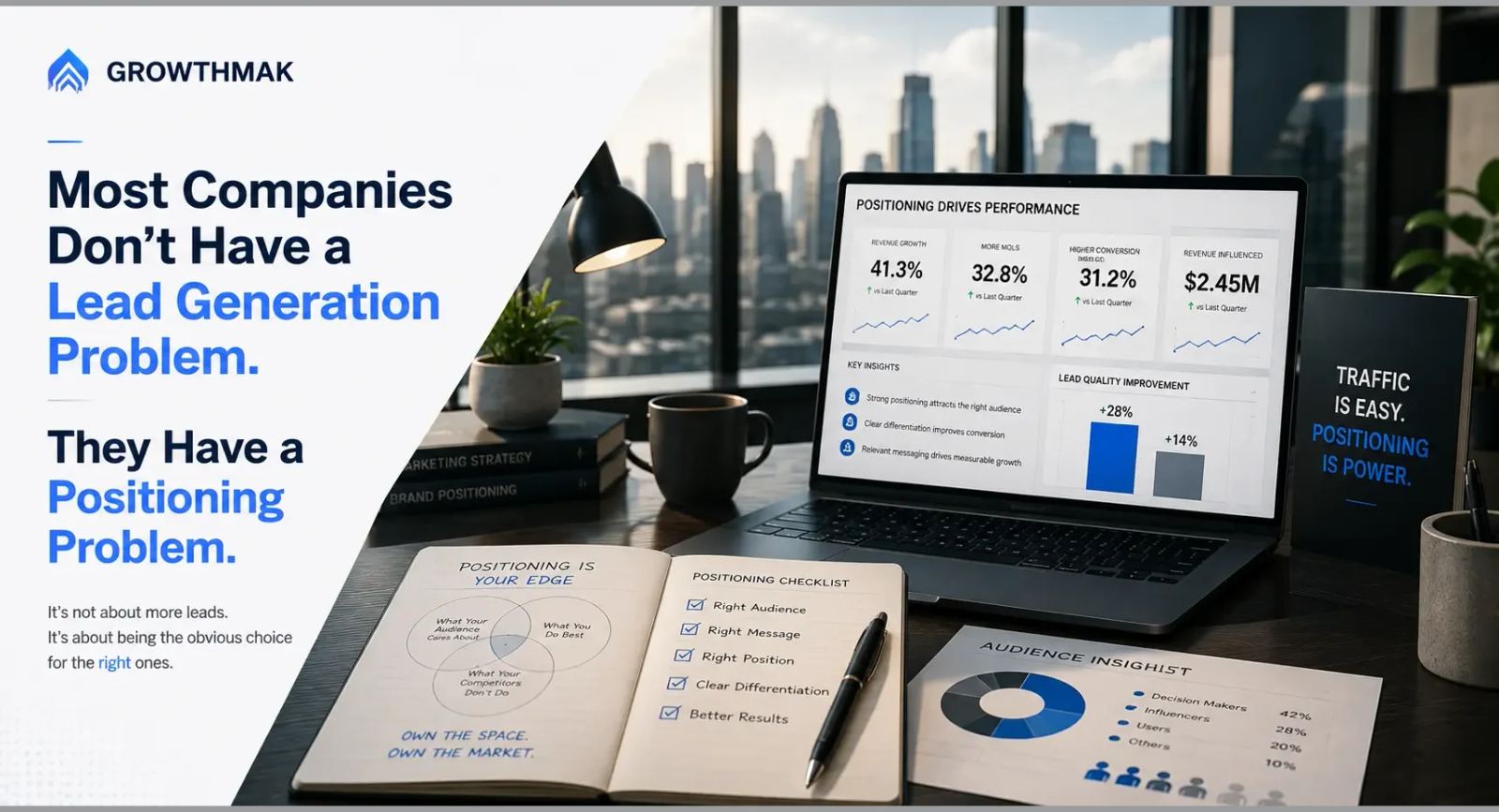
Most Companies Don't Have a Lead Generation Problem. They Have a Positioning Problem.
Your team has run the ads, published the content, hired an agency, and switched CRMs twice. The pipeline still looks thin.
Your team has run the ads, published the content, hired an agency, and switched CRMs twice. The pipeline still looks thin.
Every channel gets tried, gets tweaked, and gets blamed when the numbers don't move. Then the next channel gets the same treatment.
Somewhere in that cycle, B2B lead generation gets blamed for a problem that started somewhere else entirely, and every new fix just repeats the same underlying mistake in a new format.
Before spending on another channel, check something simpler first. Most companies don't actually have a B2B lead generation problem. They have a positioning problem wearing a lead generation costume.
Here is how the two get confused:
- A channel problem usually hits one source, not every source at once
- A positioning problem hits every channel the same way, quietly
- Sales having to explain the offer is a message symptom, not a tactics symptom
- Winning only on price is a differentiation symptom, not a targeting symptom
Is Your Problem B2B Lead Generation or Positioning
Most of the time, when every channel underperforms at once, the problem is positioning, not B2B lead generation tactics. A real lead generation problem usually shows up in one place, like a channel with a broken funnel or an audience that was never right for the offer. A positioning problem shows up everywhere, because every channel is carrying the same unclear message to a slightly different audience. The fastest way to tell them apart is to check whether the drop is isolated to one source or spread evenly across all of them.
Why B2B Lead Generation Tactics Fail When Positioning Is Wrong
Tactics amplify whatever message already exists. A better ad, a faster follow-up, or a slicker landing page all spread the same message further and faster, for better or worse.
When the underlying positioning is wrong, a stronger channel just spreads the wrong message to more people, faster, at a higher cost per result.
That is why companies can burn through three agencies and two marketing hires without the core number moving. Each new hire optimizes delivery. Nobody touches the message itself.
Running more conversion optimization tests on a page nobody understands just produces faster losses instead of slower ones. Optimization sharpens an existing message. It does not invent one from scratch.
A marketing strategy built without a clear position underneath it just distributes the same confusion more efficiently across more channels, at a higher combined cost than doing nothing at all.
When the company's own website is one of the channels repeating a confusing message, it usually needs a team that rebuilds websites around a clear position rather than another round of copywriting layered on top of the same structure.
Positioning has to be fixed before spend increases, not alongside it. Scaling a broken message just breaks it at a larger scale and a higher cost per result.
The good news is that fixing a message costs far less than fixing a product or rebuilding a sales team. It is usually the cheapest lever available, and the one pulled least often.
6 Signs You Have a Positioning Problem, Not a Lead Generation Problem
These six signs show up before the pipeline number does, if you know where to look for them.
None of them require a data team or a new dashboard to spot. Most surface in a single sales call or a single afternoon spent comparing channel performance side by side.
| Signal | Lead Generation Problem | Positioning Problem |
|---|---|---|
| One channel underperforms | Likely, check that channel first | Unlikely on its own |
| Every channel underperforms at once | Unlikely as the sole cause | Likely, a message issue |
| Sales must explain the offer repeatedly | Not directly related | Likely, the message is unclear |
| Deals are won mostly on price | Not directly related | Likely, no differentiated value proposition |
| Lead volume is low but quality is high | Likely, a reach or targeting issue | Unlikely, the message is landing correctly |
1. Every Channel Underperforms at Once
A single underperforming channel usually points to that channel specifically, a broken funnel, a bad targeting setting, or the wrong keywords.
When every channel underperforms together, even ones with completely different audiences and formats, the common thread running through all of them is the message.
Pull the last two quarters of performance across every channel side by side. A shared decline across unrelated channels is rarely a coincidence worth chasing channel by channel.
- Search, social, and outbound all show the same soft numbers
- The decline started around the same time across every channel
- New channels underperform immediately, before they've had time to fail on their own
2. Your Sales Team Has to Explain What You Do
If a prospect reads the website, watches a demo, and still asks what the company actually does, marketing has already failed at its first job.
Sales should be closing a decision the prospect already understands, not translating a confusing pitch into plain language on every single call.
Sit in on three sales calls and count how many minutes get spent explaining the basics before the real conversation starts. That number alone usually settles the question.
- Prospects ask what the company does after already reading the site
- Sales reps each explain the offer differently on calls
- Deals stall at the same explanation point every time
Time spent explaining is time not spent handling real objections. A sales team that stops re-explaining the basics on every call closes a noticeably higher share of the calls it takes.
3. You Win on Price, Not Value
Competing on price is what happens when a value proposition never got built in the first place. There is nothing else to compete on.
A clear position lets a company charge for the specific outcome it delivers, because the buyer already understands why that outcome is worth paying for.
Discounting to win a deal is a symptom worth tracking, not a pricing strategy worth repeating. Every discount reinforces that price is the only real differentiator on the table.
- Discounts get requested earlier in the sales process than they used to
- Competitors get named in nearly every deal, even unrelated ones
- The sales team asks for pricing flexibility more than product talking points
Track how often pricing comes up before the value of the outcome has even been discussed. Deals that open on price almost always closed on price too, and usually at a discount.
4. Your Lead Generation Strategy Keeps Changing, but Results Don't
Rotating through a new lead generation strategy every quarter, without ever revisiting the message underneath it, usually means the wrong variable is being tested.
The one constant across every failed tactic is the message. If the message stays vague across five different strategies, the fifth one deserves the same result as the first four.
- New tactics get tried roughly every quarter without lasting improvement
- Each new hire or agency inherits the same unclear messaging
- Short-term bumps fade back to the same baseline within weeks
Before approving another new tactic, ask whether the current message survived the last three attempts unchanged. If it did, the message is the variable that actually needs testing next, not another channel.
5. Nobody Can Repeat Your Message Back Accurately
Ask a handful of prospects, customers, or even your own team to describe what the company does in one sentence, without looking anything up.
Vague, generic, or wildly different answers point straight at a positioning gap. A clear position produces a consistent answer, because there is only one accurate way to describe it.
- Ask five people inside the company for a one-sentence description
- Ask two or three recent customers the same question
- Compare the answers for consistency, not politeness
Run this test before every major campaign, not just when results have already gone flat. Catching a drift in the message early is far cheaper than fixing it after a quarter of wasted spend.
6. Your Best Customers Look Nothing Like Your Target List
When the customers who buy fastest, pay the most, and stay the longest don't match the audience the marketing team has been targeting, the targeting was built on an assumption rather than evidence.
Best-fit customers already reveal the position that actually works. Realigning targeting around them usually outperforms guessing at a new audience from scratch.
- The customers who renew fastest came in through an unplanned channel
- The target list was built from assumptions rather than closed-deal data
- Sales keeps closing deals marketing never targeted on purpose
Pull a list of the ten best accounts by revenue and retention, then compare it honestly against who the campaigns have actually been chasing all along. The gap usually explains a great deal on its own.
Positioning Across the Buyer Journey
A clear position has to hold at every stage of the buyer decision process, not just the first ad someone sees. A gap at any single stage can stall a deal that looked healthy up to that point.
| Buyer Journey Stage | What Clear Positioning Does | What Happens When It's Missing |
|---|---|---|
| Awareness | Gives the prospect a fast, accurate reason to keep reading | Prospect scrolls past, unsure why this is relevant |
| Consideration | Frames the comparison on terms that favor the real strength | Prospect compares on price since nothing else stands out |
| Decision | Gives the buyer language to justify the choice internally | Buyer struggles to defend the choice to their own team |
| Post-purchase | Sets accurate expectations that match what was delivered | Customer feels misled even when the product performs fine |
A single missing row in that table stalls the whole sequence. A deal that survives awareness and consideration can still die at decision if the buyer can't explain the choice to a boss.
Weak positioning does not just cost the first click. It costs deals at the sales funnel stage where the buyer has to explain the purchase to someone else internally.
This matters even more in business to business sales, where a buyer rarely decides alone and has to repeat the pitch accurately to colleagues who never talked to your team directly.
That internal repetition is exactly the repeat-back test happening inside the buyer's own company, without you in the room to help it land correctly.
A position clear enough to survive that internal retelling wins deals a merely persuasive pitch never will, because it does the work even when nobody from your team is present.
What Fixing Positioning Won't Solve
Positioning cannot fix a product with no real differentiation behind the claim. If the underlying offer genuinely matches five competitors feature for feature, sharper words can only do so much.
It also cannot replace a sales process with no follow-up. A perfectly positioned company that never returns a call still loses the deal.
It cannot fix a broken pricing model either. If the economics genuinely don't work at the price the market will pay, no amount of message clarity changes that math on its own.
Positioning sharpens the message. It does not manufacture demand that was never there, and it does not substitute for a product that actually solves the problem it claims to solve.
Final Thoughts
When every channel underperforms at once, check positioning before blaming B2B lead generation, the ad platform, or the sales team.
That verdict flips when only one channel is struggling while the others perform fine. In that case, the channel itself deserves the first look, not the message.
Run the repeat-back test this week. Five honest answers will tell you more than another month of channel testing or another new lead generation strategy.
Whichever sign matched your situation, fix the message before adding a new tactic on top of it. A tactic can only carry a position. It cannot create one.
Treat this as the first question in every B2B lead generation review from now on, before the channel breakdown and before the budget conversation.
Ready to Fix Your Positioning? Explore Growthmak
Growthmak works with B2B companies whose channels are technically fine but whose core message never lands the same way twice across those channels.
If your website is one of the places that message keeps breaking down, Growthmak's website development team can rebuild the site around a position worth repeating.
Book a 30-minute growth call with Growthmak or get a growth audit for your website to identify where your messaging is losing clarity and conversion opportunities.
Frequently Asked Questions
You likely have a positioning problem if multiple marketing channels underperform despite ongoing optimization. Other signs include inconsistent messaging, frequent price-based competition, and prospects struggling to understand your value. Clear positioning should make your business easy to explain and remember.
Positioning defines how your business is perceived and the unique value it offers to a specific audience. A lead generation strategy promotes that message through marketing channels. Strong lead generation amplifies effective positioning but cannot compensate for unclear or generic messaging.
Clear positioning lowers customer acquisition cost by attracting the right audience and reducing the effort required to convert prospects. When buyers immediately understand your value, sales cycles shorten, conversion rates improve, and marketing budgets generate stronger returns across every acquisition channel.
Yes. Positioning often depends on how you communicate your value rather than changing the product itself. Clearly defining the audience, highlighting specific outcomes, and differentiating your offer can improve market perception without requiring new features or major product development.
Initial messaging improvements may produce results within a few weeks as prospects respond to clearer communication. A complete positioning update across your website, marketing campaigns, and sales process usually takes several months before delivering consistent improvements in pipeline and revenue.
Yes. Your website reflects the same positioning used across every marketing channel. If the core message is unclear, improving website design alone rarely increases conversions. Strong positioning gives visitors an immediate understanding of your value and encourages them to take action.
The buyer journey shapes how prospects evaluate your business at every decision stage. Effective positioning should answer different questions throughout awareness, consideration, and decision-making, helping buyers understand your value while giving stakeholders confidence to approve the purchase.
Small companies should prioritize positioning because a clear message helps limited sales teams work more efficiently. Strong positioning attracts better-fit prospects, reduces repetitive explanations, and enables smaller businesses to compete effectively by owning a specific market or customer outcome.
Test a new positioning statement with real prospects before updating your website or campaigns. Use it during sales conversations, monitor customer reactions, measure objection rates, and evaluate whether prospects understand your value more quickly and consistently than before.
Written by Growthmak Team · B2B Growth Specialists
All blogs