
Urban Precision
“Craft quality, matched by the digital presence.”
Client
Urban Precision
Location
Sydney, Australia
Year
2025
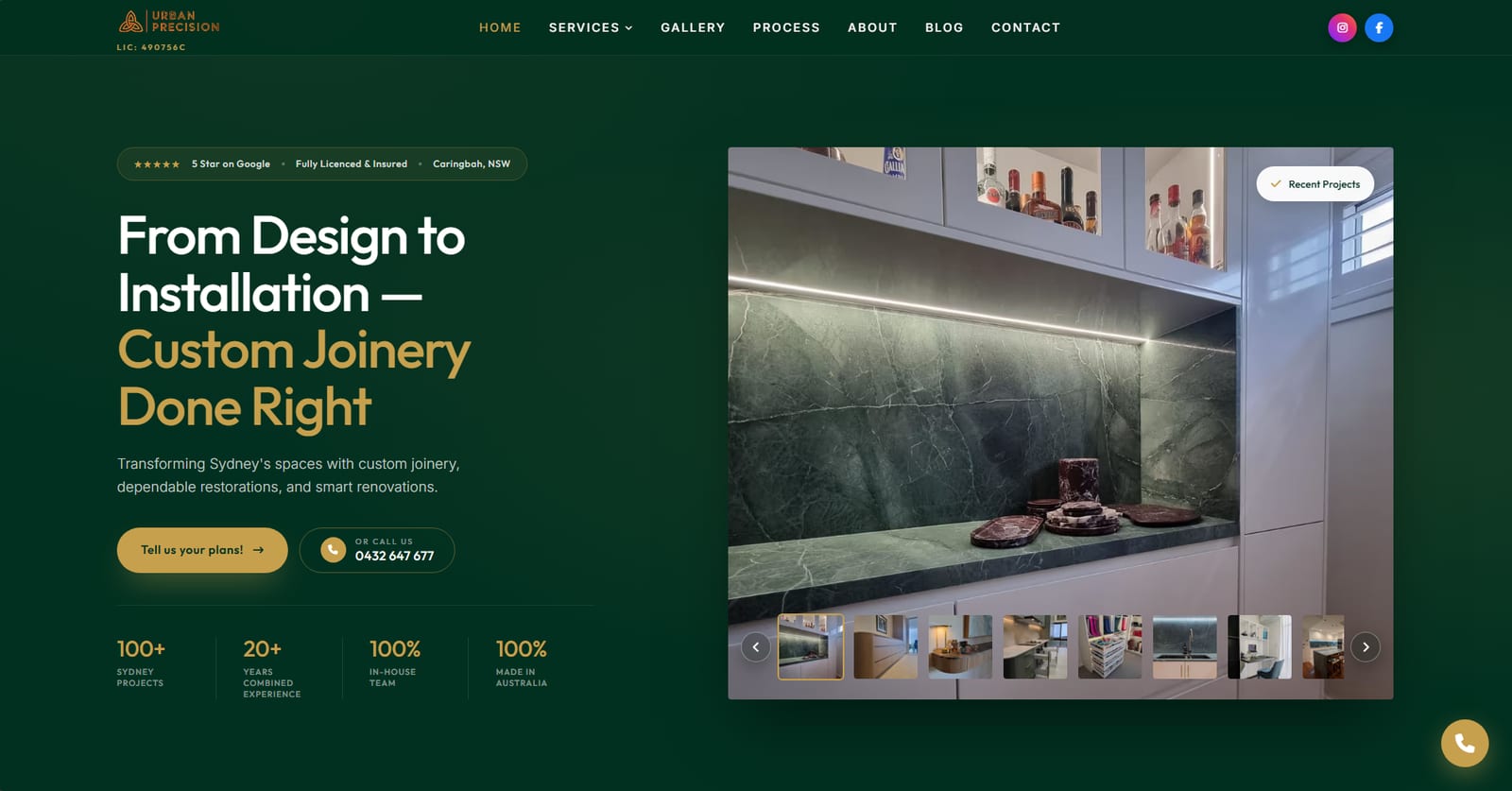
Wix → Next.js
Rebuilt off the template ceiling
4 phases
Of documented research before build
Live
Generating enquiries
A boutique custom joinery and renovation firm in Kogarah, Sydney, working at the premium end — bespoke cabinetry, custom kitchens and whole-room renovations delivered end to end. A template-bound Wix site flattened it into a generic small-business layout that undercut the perceived value of the work.
Our approach
Research-first: no design or build began until the audience, the competitive set and the build approach were resolved and documented across four sequential phases. Then a custom Next.js rebuild with real SEO architecture, a structured inspection-booking flow, a scalable portfolio model, and a Trade and Designer pathway as a secondary channel — with GA4, Search Console, GTM and Google Business Profile wired at launch.
Website strategy, architecture and build
Urban Precision is a boutique custom joinery and renovation firm based in Kogarah, in Sydney's southern suburbs, led by founder Sean O'Mahony. The business operates at the premium end of the market — bespoke cabinetry, custom kitchens, laundries, smart storage, and whole-room renovations delivered end-to-end from consultation through design, manufacture, and installation.
Growthmak was engaged to research, strategise, architect, and build a new high-performance website that would match the quality of the craft to the quality of the digital presence.
The record
- Client
- Urban Precision Pty Ltd (founder: Sean O'Mahony)
- Industry
- Premium custom joinery & residential renovation
- Project
- Website strategy, information architecture & custom build
- Project type
- Research-led website redesign & rebuild (Wix → custom Next.js)
- Services provided
- Business goal research, ICP & persona development, competitor analysis, sitemap & IA, UI/UX documentation, build
- Location / market
- St George, Sutherland Shire, Inner West & Eastern Suburbs, Sydney NSW
- Live site
- urbanprecision.com.au
- Status
- Launched — live and generating inquiries
What wasn't working
Before this engagement, Urban Precision ran a template-bound Wix website. The work behind the brand was highly considered; the site representing it was not. It flattened a premium, craft-led business into a generic small-business layout that undercut the perceived value of the work itself. Stated plainly in the Business Goal Research: excellent work quality, but insufficient social proof, no SEO architecture, and no owned digital home — visitors who found the business had no reliable way to evaluate it, trust it, or convert.
Template ceiling
The Wix platform capped performance, technical control, and the structured-data and metadata foundations a competitive local service business depends on.
Passive lead capture
Weak calls-to-action, no structured inspection-booking flow, and no way for prospects to share plans or inspiration files.
Shallow content model
No scalable way to showcase completed projects, testimonials, or service-area depth as the portfolio grew.
Undefined audience
Messaging spoke to everyone and therefore to no one, with no articulated ideal customer and no premium narrative to justify the price.
Five goals, and everything traced back to them
Five business goals were defined in the Business Goal Research and carried through every subsequent phase. Each later decision was traceable back to one of these.
- 01Generate qualified local leads — quote requests, calls, and contact-form enquiries.
- 02Establish premium positioning & trust — craft-led, not cheap.
- 03Win local organic search across Kogarah, Hurstville, St George, and the Sutherland Shire.
- 04Enable a Trade & Designer (B2B) lead-capture pathway as a secondary channel.
- 05Showcase the portfolio and build brand equity over time.
Four phases, each one a client-ready deliverable
No design or build work began until who the site was for, who it competed against, and how it should be built were resolved and documented. Each phase produced a deliverable that fed the next.
Discovery inputs included a full audit of the existing Wix site and the early Vercel homepage mockup, a completed client onboarding questionnaire from Sean, direct scraping of the top competitors, and market and SEO research across the premium Sydney joinery segment.
What the research actually turned up
Research converted into concrete problems that the architecture then had to solve. Every finding here maps to a decision later in the build — nothing was designed that didn't answer a documented problem.
No owned digital home
A template site gave the business no defensible platform, no performance headroom, and no SEO foundation.
A thin premium tier
The Sydney joinery market is saturated on the surface but genuinely thin at the premium end — most competitors compete on breadth and volume, leaving the high-craft narrative largely uncontested.
An uncontested trade segment
None of the six analysed competitors had built a dedicated Trade Partners pathway — a structural blind spot Urban Precision could claim as a first mover.
Missing trust signals
Insufficient social proof, no visible process, and no named, suburb-specific testimonials — exactly what the Renovating Homeowner persona needs to convert.
No engineered conversion moment
Lead generation relied on prospects self-qualifying and reaching out, with no deliberate booking pathway.
Answering each finding, before any build work began
Positioning & messaging
A challenger, premium-craft narrative to justify the price and separate Urban Precision from volume-driven competitors — anchored in the brand's own language: “Precision is not just a name; it's our standard.”
Audience
Two personas drove every downstream decision. The Renovating Homeowner (30–55, research-heavy, buying on trust and portfolio quality) and the Trade Partner (interior designers, architects and boutique builders, referral-first and high-repeat). A negative ICP explicitly excluded price-first, supply-only and out-of-area enquiries.
Conversion & CTA
A single, consistent primary call-to-action — “Book a Free Inspection,” drawn directly from Sean's questionnaire language — anchors conversion across the entire site.
Information architecture & SEO
A hub-and-spoke service model concentrates topical authority; project pages publish against a clean /projects/[service]-[suburb]/ URL pattern to compound local search relevance; Service Areas launch as a hub with suburb sub-pages added as project content accrues.
Technical
A custom Next.js build was chosen over the Wix status quo for performance, SEO control, a scalable content model, and full design freedom to express the premium brand.
96 sections across 22 pages
The information architecture was built at execution granularity — detailed enough that a designer, copywriter or developer could build directly from the documentation without revisiting upstream decisions. It was delivered as both a strategy document and a build-ready CSV.
Hub-and-spoke services
A central services hub linking to six dedicated spoke pages, each free to convert on its own terms.
First-mover Trade Partners page
A distinct B2B pathway no competitor offers, opening a second, higher-value lead stream.
Project pages
Published on the /projects/[service]-[suburb]/ pattern for compounding local SEO.
Phased Service Areas
Launched as a hub page, with suburb sub-pages activated as portfolio content becomes available to populate them.
Three CMS collections
Projects, Blog and Testimonials — a living content engine rather than static pages.
Navigation and conversion paths were designed so each persona has a clear route: homeowners toward suburb-specific proof and the inspection booking; trade partners toward the dedicated Trade Partners pathway and a separate contact route.
Structured, not just written
The architecture specified, section by section, the copy purpose, content elements, CTA, CMS dependencies and SEO targets for every page — giving copywriters a precise brief rather than a blank page.
Service copy
Each spoke page positioned around a distinct service — custom kitchens, laundries, bespoke cabinetry, smart storage, renovations, trade joinery — with its own conversion logic.
Proof content
Structured project case studies and named, suburb-specific testimonials surfaced contextually across service and project pages.
Authority content
A Blog collection to capture top-of-funnel search demand and reinforce the challenger positioning.
Metadata & SEO
Per-page meta titles, descriptions and local-search targets defined in the IA CSV.
Structure first, interface second
The UX process followed the standard arc: research and IA established the skeleton; wireframes and user flows defined how each persona moves toward conversion; high-fidelity UI and responsive layouts followed. User flows were modelled explicitly as a defined phase of the sitemap work — the Renovating Homeowner's path from discovery through suburb-specific proof to “Book a Free Inspection,” and the Trade Partner's separate path into the Trade Partners pathway. Conversion paths and CTA placement were resolved at the architecture stage, so design decisions inherited a validated structure rather than inventing one.
The visual direction exists to make a premium, craft-led business look premium and craft-led — the exact quality the Wix template erased. A navy-and-gold palette carries across the site and every client deliverable; the custom build removed the template constraints that had kept layout, hierarchy and imagery from foregrounding the portfolio work itself; and the hierarchy leads each persona toward the single primary CTA, with proof surfaced at the decision points.
Off the template ceiling
The site was rebuilt from a template Wix platform onto a custom Next.js stack — the decisive technical move of the project.
Nine integrations, live at launch
Confirmed for launch, giving the site full measurement and operational capability from day one.
- GA4
- Google Search Console
- Google Tag Manager
- Google Business Profile
- Google Maps
- Instagram feed
- Meta Pixel
- Calendly
- File upload on forms
A model built to be fed, not finished
The content model was designed to be fed continuously rather than built once.
- Project photography and case-study imagery, published per project against the CMS.
- Named testimonials with suburb attribution, structured for contextual reuse.
- Blog and insights articles supporting authority and top-of-funnel search.
- Brand assets and the navy/gold visual system applied across deliverables.
- Instagram feed integration to pull in live social content.
A decision-gated process
At each phase, consequential choices were presented as named options with explicit reasoning. The client either selected or deferred, and where deferred, Growthmak resolved with documented rationale rather than a silent default.
Clarity gate
An early redirect from the client established a required clarity-seeking phase before any sitemap building — CTAs, user intent, services, CMS capabilities and integrations were resolved first.
Sealed decisions
Five foundational decisions — primary CTA, service architecture, CMS collections, project URL pattern, Trade Partners page, phased Service Areas — were approved before the build phase.
Build steps
Four defined build steps — competitor analysis, user-flow modelling, dynamic routing and internal linking — were each approved before the final deliverables were produced.
Scope discipline
The client corrected course directly whenever work drifted toward generic recommendations, keeping every output tied to documented, specific decisions.
Engineered for measurement from launch
What changed
The website launched at urbanprecision.com.au, migrating Urban Precision off its Wix template onto the custom build. The full nine-integration stack was activated at launch, so the site began measuring and converting from day one.
Before
After
Wix template site
Custom Next.js build
Generic small-business layout
Premium navy/gold brand expression
Flat service presentation
Hub-and-spoke service architecture (6 services)
No trade pathway
First-mover Trade Partners page
Static content
Projects, Blog & Testimonials CMS collections
Passive contact
“Book a Free Inspection” conversion pathway
No measurement
Nine-integration analytics & ops stack
Early post-launch, reported as early post-launch
The website is recent, so results are reported honestly as early observations rather than a mature performance dataset.
Live and stable
The custom site launched successfully and is running smoothly, per direct client confirmation.
Generating inquiries
The site is producing inbound enquiries — the primary goal, qualified local lead generation, is functioning from launch.
Growth-ready
The engagement has transitioned into an active growth and optimization phase on the strength of the launch.
Clearer positioning
The brand now occupies the premium tier the research identified, defended by structure rather than messaging alone.
A scalable foundation
Execution-level IA and a CMS-led content model mean the site compounds with use rather than ageing into another refresh.
Competitive differentiation
The first-mover Trade Partners page and challenger positioning separate Urban Precision from a volume-driven field.
No traffic, ranking or conversion-rate figures are asserted. The site is early in its lifecycle; quantitative benchmarks belong to the growth and optimization phase now underway.
Each stage approved before the next began
The bottom line
Urban Precision moved from a constrained Wix brochure to a research-backed, custom-built growth platform — positioned in an underserved premium segment, engineered for professional lead acquisition, launched successfully, and already generating inquiries as it enters its growth phase.
This began with a diagnostic.
Thirty minutes on the funnel, a written plan, then the work, in that order and without exception.
See all case studies30 min
One session, no obligation
1 day
Written plan back to you
9
Markets we operate in
Find out what the same diagnostic would surface in your account.
A free 30-minute session that establishes what is actually limiting growth, before anyone proposes anything. You leave with a written plan whether or not you work with us.
- Where your funnel is losing qualified buyers, with the evidence.
- Which layer to fix first, and what it is costing you to leave it.
- Whether you need a build, an operator, or neither right now.
- A written plan you keep, with no obligation attached.