
Decoding Wisdom
“The owned home for a rented audience.”
Client
Decoding Wisdom
Location
Media brand
Year
2025
55+
Episodes given an owned home
0 → 1
Email capture, from none
4
English-language markets targeted
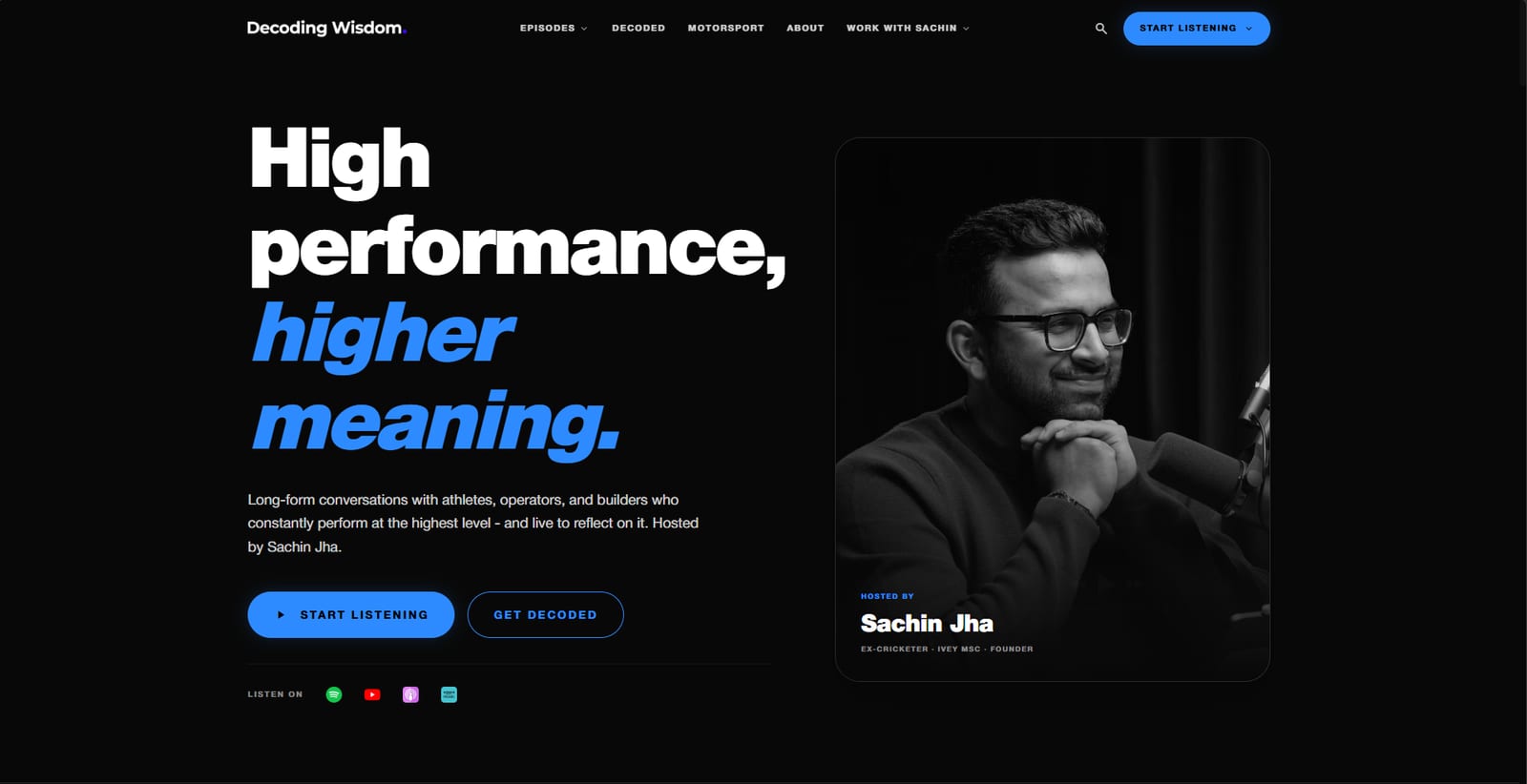
Decoding Wisdom launched in early 2025 and grew fast — 55+ episodes and a guest roster most established shows would envy. The entire brand lived on rented platforms: no website, no email capture, and episode content invisible to search. The gap was infrastructural, not creative.
Our approach
We built the canonical brand home: business-goal research, competitor analysis and persona work first, then sitemap, IA, UI/UX and the build with integrations. The site turns podcast reach into owned audience — a single URL a guest booker, sponsor or journalist can visit, email capture, and episode content structured so the guest names it earns finally capture search traffic.
Turning a rented audience into an owned asset
A 15-month-old podcast with world-class guests and zero owned infrastructure. We built the canonical brand home — strategy, information architecture, design, and a scalable CMS — that turns rented audience reach into an owned, monetisable asset.
The engagement on one card
- Client / brand
- Decoding Wisdom — personal media platform and podcast
- Host / founder
- Sachin Jha — ex-international cricketer, Ivey Business School graduate, founder of ReadyAI
- Industry
- Media and entertainment — podcasting, creator economy
- Project type
- Digital strategy, information architecture, UI/UX design and full website build
- Services provided
- Business-goal research · competitor analysis · ICP and persona development · sitemap and IA · UX/UI · web development · integrations · QA
- Content pillars
- Elite sport and performance · philosophy · creator economy · identity and belonging
- Target market
- English-language markets — Canada, USA, UK and Australia, with South Asian diaspora density
- Delivery team
- Growthmak Web Strategy Team
Strong content. No owned foundation.
Decoding Wisdom launched in early 2025 and grew fast — 55+ published episodes and a guest roster most established shows would envy: IndyCar champion Marcus Ericsson, motorsport figure James Hinchcliffe, WTA professional Maryna Zanevska, and creator-economy voice Samir Chaudry. But the entire brand lived on rented platforms.
The gap was diagnosed as infrastructural, not creative. The content was already good enough; what was missing was the owned scaffolding — website, email list, SEO and sponsorship surfaces — that converts audience reach into a durable business.
What existed before
- A distributed presence across YouTube, Spotify, Apple Podcasts, Amazon Music, Instagram and LinkedIn — every one of them a platform Sachin did not own or control.
- No website. No single URL a guest booker, sponsor, journalist or new listener could visit to understand the full brand.
- No email capture of any kind — zero owned audience relationships.
- Episode content invisible to search: valuable guest interviews locked inside podcast apps, capturing none of the Google traffic those names generate.
The rented-audience problem. Every audience touchpoint sat on a platform that could change its algorithm overnight. If Spotify re-ranked, if YouTube demonetised the niche, if Instagram deprioritized the content, reach could collapse to near-zero — and there was no owned channel to fall back on. A website with an email list was not a nice-to-have. It was existential infrastructure.
What success had to look like
Six goals defined success, ordered from foundational infrastructure through to revenue-enabling functions.
Four documents, before a single page
Rather than jumping to layout, the engagement front-loaded strategy. Each document fed the next, and the sitemap inherited from all three that preceded it.
The scale context. Every competitor launched four to nine years earlier; Decoding Wisdom was 15 months old. The point of the benchmark was never the headline subscriber number — it was trajectory. Colin and Samir built their newsletter, now 130,000+ subscribers at a 45% open rate, from zero, before their audience was large. That is the precise playbook available to Decoding Wisdom now.
Not a content gap. An infrastructure gap.
The show had world-class guests, a distinctive four-pillar positioning model, and a host whose story was genuinely rare. What it lacked was infrastructure — and infrastructure is the one thing that can be built quickly.
A hierarchy of offerings, not a list of pages
The strategy resolved the brand into three concentric layers, and every downstream decision — navigation, CTAs, CMS, integrations — traced back to it.
Five sealed decisions
Settled before design began, so layout resolved questions of execution rather than of direction.
Dual primary CTA
Listen Now, as a platform drawer, beside Get The Wisdom Stack, the newsletter lead magnet — on every key page, removing the false binary between sampling and subscribing.
User-intent tiers
Fourteen distinct user intents across seven audience groups, ranked by mission criticality, deciding which get dedicated pages, which get sub-sections, and which get reserved placeholders.
Three-layer offering hierarchy
Core, Bridge and Commercial Surface, mapped to a clean six-item top navigation.
CMS capability brief
Twenty capabilities locked across content management, visitor interaction and operational control — written platform-independent, so the tool shortlist fell out of it automatically.
Integration architecture
A defined map of which systems talk to each other, what data flows between them, and what triggers what.
Problem, strategy, solution
Built around content, not convention
The IA was driven by content type and audience need rather than service-hub convention. Four pillar landing pages shipped at launch, putting Decoding Wisdom ahead of five of six competitors, most of which rely on chronological-only archives.
The shape of it
What the architecture committed to at launch, and what it was built to grow into.
- 31 pages at launch
- 4 content pillars
- 8 user flows modelled
- 500+ URLs by year three
Why the structure took this shape
Per-episode SEO pages
Following the Huberman and Lex model — each episode gets its own indexed URL with a descriptive, keyword-rich slug leading on the guest name.
Filterable pillar taxonomy at launch
Four editorial landing pages capture topic-search traffic that would otherwise be invisible.
Be a Guest and Work with Me, front and centre
A stage-appropriate divergence: none of the six mature competitors needs an inbound guest or sponsor funnel. Decoding Wisdom, still doing outbound, does.
Reserved architectural slots
Coaching, Book and Articles URLs are reserved but unbuilt, so the site can grow into them without a restructure.
Operable by one founder
Every page, block and CTA traced back to a documented strategic rationale, and the content model was built to run without ongoing engineering support.
Where source briefs conflicted with verified project facts, the engagement defaulted to the facts rather than the more convenient copy. Content models, integrations and client details were built on what was true.
Eight flows, mapped before layout
A sitemap is not a static structure; it is a network of paths. Each flow was mapped end to end, and each one resolved a specific bottleneck.
Four make-or-break moments recurred across all eight flows: hero to Listen Now, episode page to next action, sponsor page to media-kit gate, and About to email contact. Each was given an explicit required design behaviour, so conversion happened by design rather than by accident.
Intellectually serious, emotionally accessible
The system had to feel like the home of a world-class podcast — polished but not corporate, personal but not amateurish.
CMS modules built
Dynamic templates auto-generate episode, guest, pillar and newsletter-issue pages from CMS collections, so publishing never needs a developer.
- Episodes
- Guests
- Books
- Newsletters
- Homepage
- Footer
- Speaking
- Sponsorship
- Contact
Integrations confirmed
Per-page SEO and schema: editable meta, canonical URLs and auto-generated schema markup — PodcastEpisode, Person, Article and Organization — with a self-referencing canonical policy and a full redirect map for legacy guessed URLs.
What was produced alongside the build
- Structured show notes and metadata for the existing episode back-catalogue.
- Guest bios and photography feeding the auto-generated guest pages.
- The Wisdom Stack lead-magnet PDF as the newsletter entry point.
- A reusable component library — testimonials, sponsor logos, CTA blocks and lead-magnet forms defined once and used site-wide.
- Media-kit and press-kit assets for the commercial and press surfaces.
A 121-issue checklist, tracked to zero
The site evolved through structured client-feedback rounds, each tracked against a single master checklist so nothing slipped between iterations.
What pre-launch testing covered
The patterns from these rounds later became a reusable, project-agnostic pre-launch checklist for future engagements.
Functional and UX
Navigation, links, buttons, CTAs, forms, video and audio players, and all three inquiry-form integrations.
Responsive
Mobile, tablet and desktop layouts across browsers, with mobile-first behaviour verified.
Performance
PageSpeed, Core Web Vitals, image optimization and lazy loading.
SEO
Sitemap, robots.txt, metadata, canonicals, schema and Search Console indexing.
Live, with measurement from day one
Analytics and search infrastructure were configured at launch rather than after it — critical for demonstrating growth to future sponsors.
- 01Final QA sign-off against the 121-issue checklist.
- 02Production deployment with SSL and a custom domain.
- 03Analytics activation — GA4, Google Search Console and Microsoft Clarity live at launch.
- 04Newsletter capture wired to Substack with the lead-magnet delivery flow.
- 05All three inquiry forms — sponsor, guest and speaker — routed and confirmed.
What actually changed
A canonical brand home that does three jobs at once: it builds the owned foundation, surfaces the four-pillar positioning as an SEO advantage, and stays simple enough for one founder to operate.
Before
After
No owned website — presence scattered across six rented platforms
A single canonical home at the brand domain
No email capture anywhere
Dual-CTA newsletter capture site-wide, wired to Substack
Episodes invisible to Google
Per-episode and per-guest SEO pages with schema markup
Chronological-only discovery
Four filterable content-pillar landing pages
Spotify links in every guest pitch
A dedicated Be a Guest page with a past-guest wall
Pitch decks assembled by hand per sponsor
A Work with Sachin surface with a gated media kit
No speaker profile
An About page with a dedicated speaker section
What the build put in place
This engagement is recent, so these are the structural gains the build delivered rather than long-run performance data.
- A canonical brand home now exists — one URL that guest bookers, sponsors, journalists and new listeners can be pointed to.
- Owned-audience infrastructure is live: newsletter capture replaces a wholly rented audience relationship.
- Every episode and guest is now an indexable SEO surface, capturing search traffic that previously flowed only to podcast apps.
- The brand is sponsor-ready — a media kit and inquiry funnel replace hand-built pitch decks.
- Sachin’s speaker narrative is now visible to event organizers for the first time.
- A scalable content model lets a single founder publish new episodes without engineering support.
The targets it is measured against
These were set during the strategy phase. Live figures will be published against them as the site matures — measured, not estimated.
Strategy first, launch last
Each phase was signed off before the next began.
The infrastructure is not the reward for growing.
The infrastructure is what enables the growing. Decoding Wisdom’s content was already good enough — the building needed to happen now.
This began with a diagnostic.
Thirty minutes on the funnel, a written plan, then the work, in that order and without exception.
See all case studies30 min
One session, no obligation
1 day
Written plan back to you
9
Markets we operate in
Find out what the same diagnostic would surface in your account.
A free 30-minute session that establishes what is actually limiting growth, before anyone proposes anything. You leave with a written plan whether or not you work with us.
- Where your funnel is losing qualified buyers, with the evidence.
- Which layer to fix first, and what it is costing you to leave it.
- Whether you need a build, an operator, or neither right now.
- A written plan you keep, with no obligation attached.