How to Build a Scalable Growth Marketing Strategy for Business Success
Why do some businesses grow effortlessly while others spend thousands on marketing and barely move the needle? The answer usually isn't budget, it's strategy. Specifically, it's whether or not the business is using growth marketing.
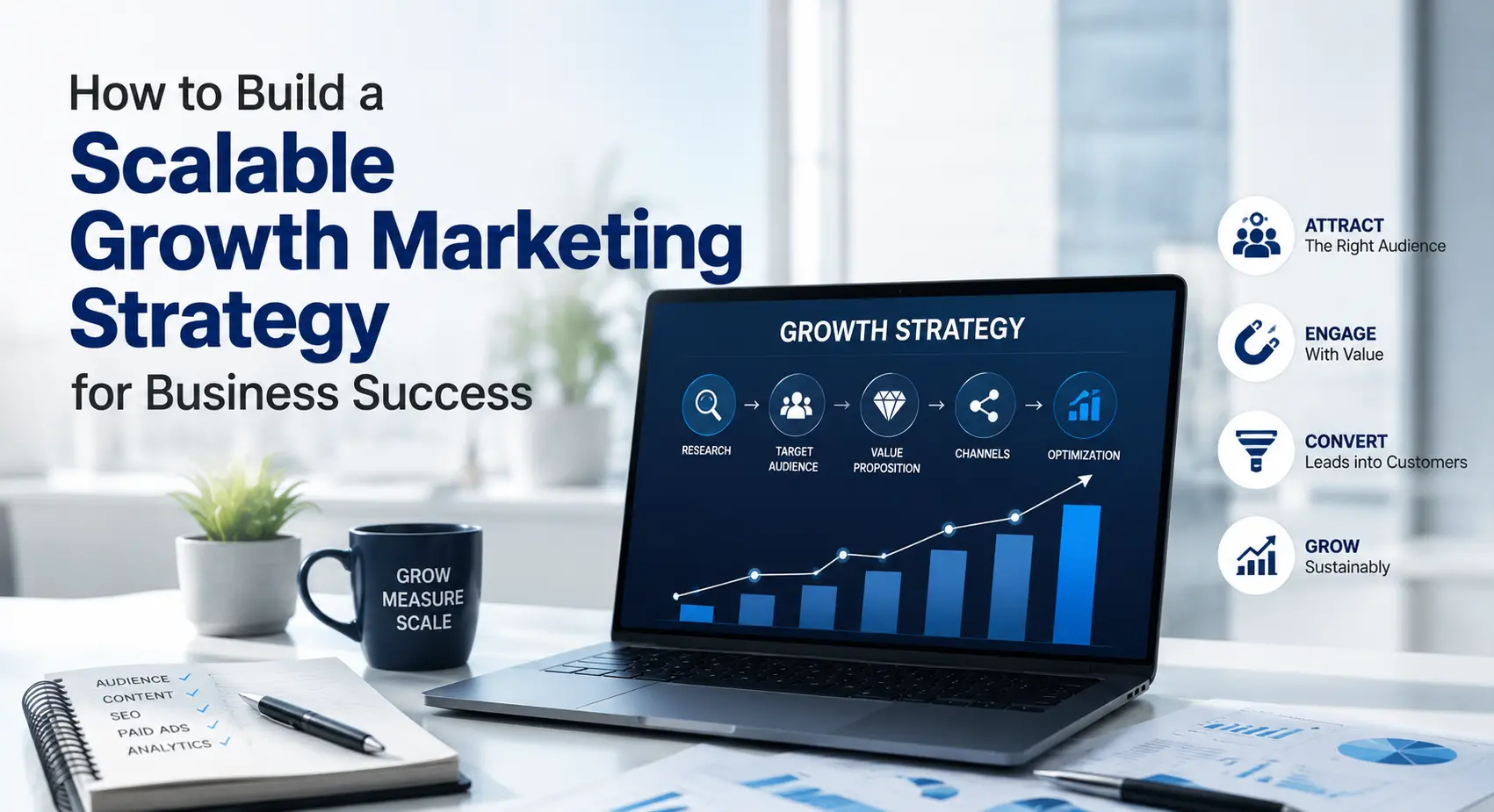
Traditional marketing focuses on awareness and campaigns. Growth marketing focuses on the entire customer journey from the first moment someone hears about your brand to the point where they become a loyal, referring customer. It's data-driven, iterative, and designed to compound over time.
In this guide, we'll explore how to build a scalable growth marketing strategy for business success, including the growth marketing strategies, tools, and frameworks businesses use to improve customer acquisition, conversion, retention, and long-term revenue growth.
What Is Growth Marketing?
Growth marketing is a full-funnel, data-driven approach to driving sustainable business growth. Unlike traditional marketing, which typically focuses on top-of-funnel awareness, growth marketing optimizes every stage of the customer lifecycle acquisition, activation, retention, revenue, and referral.
It combines creative thinking with rigorous testing and analysis. Growth marketers run experiments, measure results, and double down on what works. The goal isn't just to drive traffic, it's to build a system that grows revenue predictably and efficiently over time.
Growth marketing is widely used in SaaS, e-commerce, B2B, and startups, but its principles apply to any business serious about scaling.
The Growth Marketing Funnel Explained
The growth marketing funnel maps the entire customer journey not just the top. Each stage represents a critical lever for growth:
- Awareness: Getting in front of the right audience through SEO, content, social, and paid channels
- Acquisition: Converting that audience into leads, users, or subscribers
- Activation: Delivering the first meaningful value moment that makes users stick
- Retention: Keeping customers engaged and coming back over time
- Revenue: Maximizing the value of each customer through upsells, cross-sells, and pricing optimization
- Referral: Turning satisfied customers into advocates who bring in new business
Most businesses only optimize the first two stages. Growth marketing wins by optimizing all of them. Strong activation and retention strategies across every stage of the growth marketing funnel help businesses improve customer engagement and long-term retention.
Top Growth Marketing Strategies to Scale Faster
Build a Data-Driven Marketing Foundation
Growth marketing lives and dies by data. Before you can optimize your funnel, you need to understand what's actually happening in it. Businesses that prioritize business growth strategies through experimentation and data analysis are more likely to scale efficiently over time. That means tracking the right metrics and using them to guide decisions.
Key metrics to monitor include Customer Acquisition Cost (CAC), Customer Lifetime Value (LTV), monthly recurring revenue (MRR), churn rate, and activation rate. Tools like Google Analytics, Mixpanel, and HubSpot help you visualize this data and identify where users are dropping off.
When decisions are guided by data rather than gut instinct, you spend the budget where it produces results not where it feels right. A strong data-driven marketing approach helps businesses build scalable marketing strategies that support long-term growth.
Optimize for Conversion Rate (CRO)
Driving traffic to a website that doesn't convert is one of the most common ways businesses waste marketing budgets. Conversion rate optimization (CRO) ensures that the traffic you already have produces better outcomes.
CRO involves testing your landing pages, call-to-action buttons, headlines, form lengths, and user flows. Even a one to two percent improvement in conversion rate can have a dramatic impact on revenue without spending more on acquisition. Effective conversion rate optimization is one of the most important customer acquisition strategies for improving marketing performance.
Use tools like Hotjar for heatmaps and session recordings to understand where users hesitate or drop off, then run A/B tests to fix those friction points.
Invest in Content Marketing and SEO
Content marketing and SEO are the closest thing to a compounding growth asset in digital marketing. Unlike paid ads, which stop the moment you stop paying, content continues to generate traffic and leads for months or years after it's published.
Build a content strategy around topic clusters, a central pillar page covering a broad topic, supported by related blog posts that dive into specific aspects. This structure helps you rank for more keywords, build topical authority, and create a clear user journey through your site.
Focus on content that addresses every stage of your buyer's journey, from awareness-stage educational posts to decision-stage comparison guides and case studies.
Leverage Marketing Automation
Marketing automation allows you to scale personalized communication without scaling your headcount. Once set up, automated workflows nurture leads through your funnel, re-engage inactive users, and deliver the right message at the right moment automatically.
Common automation workflows include welcome sequences for new subscribers, lead nurturing drip campaigns, abandoned cart recovery, re-engagement emails for dormant contacts, and onboarding sequences for new customers.
The key to effective automation is behavioral triggers. Rather than sending time-based emails, automation tied to user actions creates far more relevant and timely communication.
Focus on Customer Retention and LTV
Acquiring a new customer costs significantly more than retaining an existing one. Yet many businesses invest heavily in acquisition and almost nothing in retention. This is one of the biggest missed opportunities in growth marketing.
Reducing churn by even a small percentage can have a significant impact on revenue. Build strong onboarding experiences that help users get value quickly. Use loyalty programs, personalized check-ins, and re-engagement campaigns to keep customers active.
Focus on maximizing customer lifetime value (LTV) through upsells, cross-sells, and product expansion. The more value your customers get, the longer they stay and the more they spend.
Run Continuous Growth Experiments
Growth marketing is fundamentally an experimentation discipline. The teams that grow fastest are those that test the most and learn the fastest. Adopt a Build-Measure-Learn approach: form a hypothesis, run an experiment, measure results, and apply the learnings.
Use the ICE framework to prioritize experiments: score each idea by its potential Impact, Confidence in the expected outcome, and Ease of execution. Focus on high-ICE experiments first to generate quick wins and build momentum.
Not every experiment will succeed and that's fine. Failed tests provide data that guides future decisions. The goal is to learn faster than your competitors.
Use Performance Marketing Strategically
Paid advertising can accelerate growth, but only when used strategically. The key is maintaining a healthy ratio between Customer Acquisition Cost (CAC) and Customer Lifetime Value (LTV). If CAC exceeds LTV, you're paying to lose money.
Start with highly targeted campaigns on platforms where your audience is most active. Use retargeting to re-engage people who visited your site but didn't convert. Test different ad formats, messaging, and audiences rigorously before scaling spend.
Performance marketing works best as an accelerant layered on top of a strong organic foundation not as your only growth channel. A successful cross-channel marketing strategy combines SEO, paid ads, email marketing, and social media to improve customer acquisition and engagement.
Build a Referral and Viral Growth Loop
Word-of-mouth is the most powerful and most cost-effective growth channel but it doesn't always happen on its own. You can design it.
Referral programs marketing incentivize existing customers to bring in new ones. When the incentive is valuable and the sharing mechanism is frictionless, referral programs can create a viral growth loop where each new customer generates additional customers.
Product-led growth takes this further by building virality directly into the product where using the product naturally exposes it to new potential users. Think about how tools like Slack, Zoom, and Dropbox grew primarily through product sharing.
Personalize the Customer Experience
Generic marketing produces generic results. The more personalized your marketing, the more relevant it feels and the more it converts.
Personalization doesn't have to mean complex AI. Start by segmenting your audience by behavior, industry, or funnel stage, and tailor your messaging accordingly. Send different email campaigns to trial users vs. paying customers. Show different website content to first-time visitors vs. returning ones.
As you gather more data on your users, you can layer in more sophisticated personalization through behavioral triggers, dynamic content, and AI-driven recommendations.
Align Teams Around a North Star Metric
One of the biggest growth killers is fragmented focus. Marketing chases one metric, product chases another, sales chases a third and nothing compounds.
A North Star Metric (NSM) is the single metric that best captures the core value your business delivers to customers. For a SaaS company, it might be weekly active users. For an e-commerce brand, it might be monthly orders.
When every team understands and optimizes for the North Star Metric, their efforts align and compound. Growth becomes a coordinated, cross-functional effort rather than a series of isolated campaigns.
How to Build a Scalable Growth Marketing System
- Set clear growth goals with specific, measurable targets
- Map your funnel and identify the biggest bottlenecks at each stage
- Build a culture of testing, learning, and iteration
- Invest in the right analytics tools and data infrastructure
- Review performance weekly and adjust strategies based on results
Common Growth Marketing Mistakes to Avoid
- Investing entirely in acquisition while neglecting retention
- Running underpowered experiments that don't reach statistical significance
- Chasing tactics from competitors without a clear strategic fit
- Failing to define success metrics before launching campaigns
- Scaling channels before proving they work at a smaller level
Why Choose GrowthMak for Growth Marketing
GrowthMak is a leading growth marketing agency and helps businesses build growth marketing systems that are designed to scale, not just generate short-term spikes. From funnel audits and conversion optimization to content strategy and performance marketing, GrowthMak takes a data-driven, full-funnel approach to driving real business growth.
- Growth audit and funnel analysis to identify key bottlenecks
- Content marketing and SEO strategy for long-term organic growth
- CRO and landing page optimization
- Marketing automation setup and management
- Performance marketing management with a focus on CAC/LTV
Final Thoughts
Building a scalable growth marketing strategy requires the right mix of data, experimentation, customer retention, and long-term optimization. When built correctly, it creates a compounding loop where each win builds on the last, acquisition costs decrease, and revenue scales predictably.
The businesses that grow fastest aren't necessarily the ones with the biggest budgets. They're the ones with the clearest strategy, the most disciplined testing culture, and the strongest focus on customer value at every stage of the funnel.
Start with your data, identify your biggest bottleneck, and run your first experiment. Growth is a discipline and it starts with a single well-informed step.
FAQs
Growth marketing is a data-driven, full-funnel approach to driving sustainable business growth. Unlike traditional marketing, it optimizes every stage of the customer journey from acquisition and activation through retention and referral using experimentation, analytics, and continuous improvement.
Traditional marketing typically focuses on brand awareness and top-of-funnel campaigns. Growth marketing takes a broader view, optimizing every stage of the funnel and focusing on measurable outcomes like revenue growth, retention, and lifetime value rather than just impressions or clicks.
The growth marketing funnel represents all stages of the customer journey: Awareness, Acquisition, Activation, Retention, Revenue, and Referral. Growth marketers optimize each stage to reduce friction, improve conversion, and maximize the value of every customer interaction.
Key metrics include Customer Acquisition Cost (CAC), Customer Lifetime Value (LTV), conversion rates at each funnel stage, churn rate, Monthly Recurring Revenue (MRR), and the North Star Metric specific to your business model.
Popular tools include Google Analytics and Mixpanel for data analytics, HubSpot for CRM and automation, Hotjar for user behavior insights, Optimizely for A/B testing, and tools like Apollo.io or Mailchimp for email and outreach campaigns.
It depends on the strategies used. Paid advertising can generate results within days. Content marketing and SEO typically take three to six months to build momentum. Retention and referral improvements can show impact within weeks. Growth marketing is a long-term investment, but the returns compound significantly over time.
Yes, absolutely. Growth marketing works for businesses of all sizes, including small businesses. They can start with simple strategies like improving landing pages, testing email campaigns, and optimizing customer experience. By continuously testing and improving what works, small businesses can achieve steady growth without requiring a large budget.
Written by Growthmak Team · B2B Growth Specialists
All blogs