10 Proven Ways to Get Qualified B2B Leads in the US
Many U.S. B2B companies don't have a lead volume problem. They have a lead quality problem. A pipeline stuffed with unqualified contacts drains sales capacity, inflates CPL, and creates false confidence in your marketing numbers. With the average B2B cost per lead running $198 to $213 across channels in 2026 (based on aggregated 2025, 2026 CPL benchmark data), you can't afford to pay for contacts that never convert.
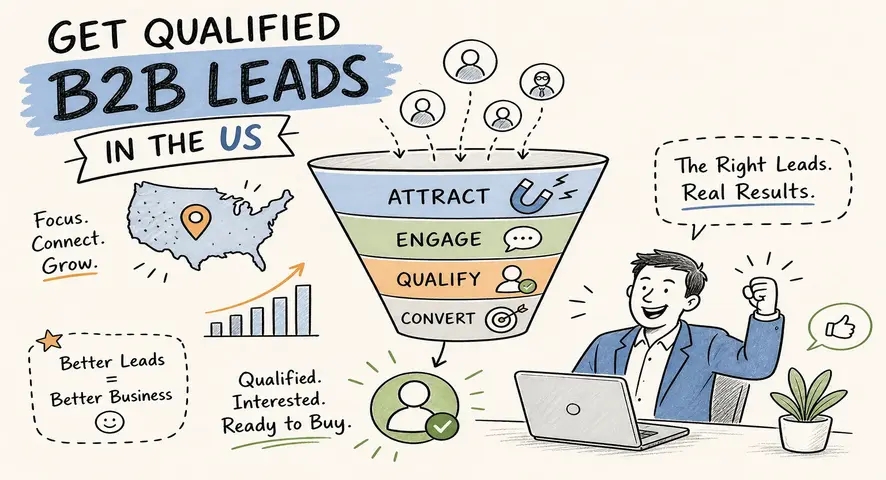
The fix isn't more leads. It's better-qualified ones. If you want to know how to generate qualified B2B leads in the US, this is the same playbook the team at Growthmak uses with U.S.-based SMBs, not through higher volume, but through sharper targeting, smarter scoring, and tighter sales-marketing alignment.
What follows is a practical, channel-specific breakdown of 10 proven tactics to generate and convert qualified B2B leads in the U.S. market.
Define Your ICP Before You Spend a Dollar on Outreach
Every tactic in this article only works if you know exactly who you're targeting. Without a sharp Ideal Customer Profile, you're generating volume, not pipeline. The ICP is the filter that determines whether your spend produces revenue or just reports.
Tactic 1: Build Your ICP Using Firmographics and Technographics
Start with the account-level attributes that define your best-fit customers: industry, company size (employee count and revenue), geography, and growth stage. These firmographic filters eliminate low-probability accounts before you spend a cent on outreach. Layer in technographic signals next, what tools the prospect already uses, whether your product integrates with their stack, and whether there's a replacement or adjacency opportunity.
Firmographic plus technographic targeting is the combination that top-performing B2B demand gen teams use to reduce wasted ad spend. The goal is to narrow your universe to accounts where the probability of conversion is structurally high, not just directionally possible.
Tactic 2: Add Intent Signals to Your ICP Qualification
A static ICP tells you whether an account fits. Intent signals tell you whether they're actually in a buying window right now. Pricing page visits, demo requests, high-intent content downloads, and competitor research are all signals that a well-fitted company is actively evaluating solutions. Tools like ZoomInfo, Bombora, and Apollo.io let you layer these intent signals onto your existing ICP filters to surface account showing active buying behavior.
Start with three to four high-signal criteria, validate them against your closed-won data, then expand. The fastest way to ruin a scoring model is to make it too complex before you've confirmed which signals actually predict revenue in your specific market.
How to Generate Qualified B2B Leads in the US: Top Channels
Channel selection is a strategic decision, not a spray-and-pray exercise. Each channel carries a different CPL, SQL rate, and audience profile. Picking the wrong one means paying premium prices for leads that rarely close. The three channels below offer the strongest ROI logic for U.S. B2B companies running qualified B2B lead generation strategies in 2026.
Tactic 3: LinkedIn for Decision-Maker Targeting at Scale
LinkedIn's job-title targeting, company filters, and Lead Gen Forms make it one of the most precise B2B audience platforms available for reaching decision-makers at scale. The trade-off is cost: expect CPL in the $200 to $400 range, with a cost per qualified lead (CPQL) averaging around $387 based on 2026 LinkedIn benchmark data. Lead Gen Forms can lower your CPL, but they often reduce intent quality because the friction of a landing page visit is removed.
Use LinkedIn for top-of-funnel awareness and retargeting, not just cold outreach. The platform works best when it's part of a sequenced approach: create initial visibility, warm the audience, then convert through more direct channels. MQL-to-SQL conversion rates on LinkedIn typically run 10 to 20%, which means your targeting precision has to compensate for the lower conversion floor.
Tactic 4: Google Paid Search for Buyers Who Are Already Looking
Paid search captures high-intent demand rather than creating it. Someone searching for your category is already in a buying mindset, a fundamentally different signal than an impression on a social feed. Branded and long-tail keyword strategies tend to be more cost-efficient, with CPL in the $75 to $250 range for most
U.S. B2B categories and SQL conversion rates of 15 to 30%, according to 2026 paid-search benchmarks. Competitive categories and niche verticals will see meaningful variation from these baselines.
Landing page continuity is a frequently underemphasized conversion lever in paid search that can materially improve results. If the ad speaks to a specific pain point and the landing page doesn't continue that exact conversation, you're bleeding qualified clicks. Match the message, match the audience, and match the CTA to the intent level of the keyword. (See How to Create Compelling B2B Marketing Content That Resonates (And Drives Growth).)
Tactic 5: Cold Email Outreach with Multi-Touch Cadences
Cold email delivers CPL in the $30 to $120 range with SQL conversion rates of 25 to 40% when list quality and personalization are strong, based on 2025, 2026 outreach benchmarks. A high-performance cadence runs five to eight touches over two to three weeks, alternating email and LinkedIn. Short subject lines, "Question," "Idea for [Company]," or "Quick thought", tend to outperform longer, promotional-sounding alternatives in most outreach benchmark datasets.
The first CTA should ask for interest, not a meeting. Requesting a meeting in the first touch can cut reply rates by up to 50% versus a curiosity-based ask. Personalize around a real business trigger: a new hire, a recent funding round, a product launch, or a job posting that signals organizational change. One relevant line of research beats five generic value propositions every time. Learn more on building an effective email cadence for outreach sequences.
Lead Scoring That Separates Real Buyers from Tire-Kickers
Lead scoring is the connective tissue between marketing activity and sales productivity. Without it, your sales team wastes capacity on contacts that were never ready to buy, and your MQL-to-SQL conversion rate becomes a vanity number with no predictive value.
Tactic 6: Build a Scoring Model Using Fit, Intent, and Engagement
The signals that actually predict pipeline quality fall into three categories, and a well-calibrated scoring model weights them accordingly. Fit, firmographics, job title, and geography, tells you whether the account belongs in your universe at all. Intent signals like pricing page visits, demo requests, and content downloads indicate active evaluation. Engagement data (email clicks, webinar attendance, repeat site visits) confirms that interest is building over time. Assign point values to each signal tier, weight the higher-intent actions more heavily, and set a clear MQL threshold before a lead gets handed to sales.
The cross-industry average MQL-to-SQL conversion rate in U.S. B2B sits at 13%, but top-quartile teams hit 28% or higher. The difference is almost always qualification rigor. B2B SaaS teams with tight scoring models typically see 18 to 22% conversion, and the best-performing teams reach 25 to 35%. For further context on industry benchmarks, see these MQL-to-SQL conversion rate benchmarks.
Tactic 7: Define MQL-to-SQL Handoff Criteria with Your Sales Team
The most common reason MQL-to-SQL conversion stalls has nothing to do with lead volume. It's that marketing and sales define "qualified" differently. Marketing passes a lead; sales rejects it. Both teams have a different mental model of what readiness looks like, and no one has written it down. A shared SLA document that defines SQL criteria explicitly solves this problem.
SQL qualification in practice means four things are confirmed: authority (the contact can influence or
make the decision), articulated need (there's a real business problem on the table), a budget signal (spend is realistic and available), and a timeline (there's a real window for a decision). Documenting this with your sales team and enforcing it at handoff is one of the highest-leverage, lowest-cost improvements any B2B marketing team can make.
How to Generate Qualified B2B Leads in the US: Lead Scoring and ABM
ABM is a high-precision motion for B2B companies with identifiable target accounts, particularly those with ACVs above $25K where account-level personalization justifies the investment. It's not a replacement for broad demand gen; it's a precision layer on top of it. The companies that get the most out of ABM treat it as a motion for their highest-fit, highest-ACV accounts, not as a substitute for scalable inbound or outbound programs.
Tactic 8: Select and Prioritize Target Accounts Using Intent Data
Start with a list of 50 to 200 high-fit accounts built from your ICP filters. Layer Bombora's topic-level demand signals or ZoomInfo's real-time intent triggers to identify which of those accounts are in an active buying window right now. Prioritize outreach to accounts showing active signals first; don't burn budget on well-fitted accounts that aren't in market yet. Some implementations using intent-driven ABM prioritization have reported a meaningful lift in average deal size versus traditional demand gen, though results vary by industry and execution quality.
Tactic 9: Personalize Outreach at the Account Level Without Losing Scale
Effective ABM personalization doesn't mean writing a custom email for every contact. It means anchoring your messaging to a real, account-specific trigger: a new executive hire, a funding announcement, a product launch, or a recent G2 review that signals a specific pain point. Company-specific landing pages, ad creative tailored to the account's industry challenge, and email sequences tied to real business context all create the feeling of relevance without requiring fully bespoke execution.
At Growthmak, ABM campaigns for U.S. B2B SMBs combine LinkedIn targeting, Google retargeting, and personalized email sequences to accelerate pipeline from a defined list of target accounts. The result is shorter sales cycles and higher deal values from the accounts that matter most.
U.S. Compliance, KPIs, and Your 30/90-Day Execution Plan
Knowing what to do is only half the problem. Sequencing it correctly and measuring the right things is
where most B2B marketing teams fall short. This section bridges knowledge into action.
Tactic 10: Stay Compliant with U.S. Advertising and Outreach Standards
U.S. B2B outreach in 2026 touches three distinct compliance areas, and gaps in any one of them can damage more than just your legal standing. Start with email: the CAN-SPAM Act requires accurate sender identity, non-deceptive subject lines, a valid physical address, and a working opt-out mechanism honored within 10 business days. Phone outreach falls under TCPA, which requires written consent before sending automated or prerecorded calls and texts to wireless numbers, a requirement that has generated significant litigation, so written documentation matters. LinkedIn and Google campaigns are governed by each platform's data use and targeting policies, which restrict how audience data is collected and applied. For a concise overview of the CAN-SPAM requirements, consult this guide on the CAN-SPAM Act.
Compliance protects your sender reputation and channel deliverability as much as your legal standing. A suppression list failure or deceptive subject line doesn't just risk a fine; it destroys the inbox placement that makes your entire email program work. State-level privacy laws add another layer, particularly in California, Colorado, and Virginia, so confirm your outreach practices against current state guidance as well.
The KPIs That Actually Predict Revenue Quality
Track CPL by channel, MQL-to-SQL conversion rate, sales cycle length by lead source, pipeline velocity, and cost per qualified opportunity (CPQO). Tracking leads generated without tracking MQL-to-SQL conversion creates false confidence. You may be producing volume while your revenue metrics stall. The metrics that matter are the ones that connect marketing activity to closed revenue, not just top-of-funnel output. For additional context on benchmark CPLs across channels, see these B2B cost per lead benchmarks.
A Realistic 30/90-Day B2B Lead Generation Rollout
Days 1, 30: Finalize your ICP using firmographic and technographic filters. Set up your lead scoring model with defined MQL and SQL thresholds. Activate the one or two highest-fit channels for your audience and install tracking across all touchpoints.
Days 31, 90: Run your first A/B tests on ad creative and email sequences. Review MQL-to-SQL conversion data by channel, cut underperforming sources, and double down on what converts. Treat this as a repeatable sprint, not a one-time setup project.
Build a Pipeline That Actually Converts
Generating qualified B2B leads in the U.S. is not about doing more. It's about doing the right things in the
right sequence. The 10 tactics in this article cover the five areas that determine pipeline quality: ICP definition, channel selection, lead scoring, account-based marketing, and compliance, with an execution plan to tie it all together.
Don't try to run all 10 at once. Pick the two or three tactics most relevant to your current pipeline stage and implement them over the next 30 days. A sharply defined ICP plus one well-executed channel will outperform a broad, unfocused program across five channels every time. For alternative and complementary approaches, consider reading Beyond Traditional Marketing: B2B Growth Hacking Strategies That Actually Work.
For SMBs that want a proven partner to build and run this system, Growthmak's B2B lead generation practice has helped 50+ U.S. companies move from inconsistent outbound to predictable, qualified pipeline. If you want to learn how to generate qualified B2B leads in the US consistently and stop paying for leads that don't convert, schedule a free strategy session with the Growthmak team and get a channel-specific plan built for your ICP and revenue goals. Learn more about our approach in Mastering B2B Lead Generation for Increased Revenue.
Frequently Asked Questions
U.S. businesses can generate qualified B2B leads by focusing on better audience targeting, identifying ideal customer profiles, tracking buyer intent signals, choosing the right lead generation channels, and building a structured qualification process that helps attract prospects who are genuinely ready to buy.
Many businesses focus heavily on increasing lead volume instead of improving lead quality. Poor audience targeting, weak qualification systems, and lack of proper lead scoring often bring unqualified prospects into the pipeline, which reduces conversion opportunities and creates wasted marketing and sales efforts.
Improving lead quality starts with understanding the right target audience and focusing on prospects that match your ideal customer profile. Businesses can improve lead quality by using better targeting strategies, intent-based marketing, proper lead qualification, and choosing channels that attract serious buyers.
The most effective channels for generating qualified B2B leads often include LinkedIn advertising, Google paid search, cold email outreach, retargeting campaigns, and account based marketing. These channels help businesses connect with decision-makers while improving lead quality and increasing conversion opportunities over time.
Many B2B leads fail to convert because businesses often attract prospects who are not ready to buy or do not match the right customer profile. Weak lead qualification processes, poor sales follow-up, and ineffective targeting frequently reduce conversion rates and impact overall revenue growth.
Lead scoring helps businesses identify prospects based on customer fit, engagement behavior, and buying intent. By prioritizing high-quality prospects, companies can improve conversion efficiency, reduce wasted sales efforts, and build a stronger pipeline filled with leads that show real purchase interest.
Businesses can attract decision-makers by improving audience targeting, understanding buyer intent, selecting better lead generation channels, and creating personalized outreach strategies. Focusing on high-intent prospects instead of broad lead generation helps companies generate qualified leads that create stronger long-term business growth.
Build a Pipeline That Actually Converts
Generating qualified B2B leads in the U.S. is not about doing more. It's about doing the right things in the
right sequence. The 10 tactics in this article cover the five areas that determine pipeline quality: ICP definition, channel selection, lead scoring, account-based marketing, and compliance, with an execution plan to tie it all together.
Don't try to run all 10 at once. Pick the two or three tactics most relevant to your current pipeline stage and implement them over the next 30 days. A sharply defined ICP plus one well-executed channel will outperform a broad, unfocused program across five channels every time. For alternative and complementary approaches, consider reading Beyond Traditional Marketing: B2B Growth Hacking Strategies That Actually Work.
For SMBs that want a proven partner to build and run this system, Growthmak's B2B lead generation practice has helped 50+ U.S. companies move from inconsistent outbound to predictable, qualified pipeline. If you want to learn how to generate qualified B2B leads in the US consistently and stop paying for leads that don't convert, schedule a free strategy session with the Growthmak team and get a channel-specific plan built for your ICP and revenue goals. Learn more about our approach in Mastering B2B Lead Generation for Increased Revenue.
Written by Growthmak Team · B2B Growth Specialists
All blogs