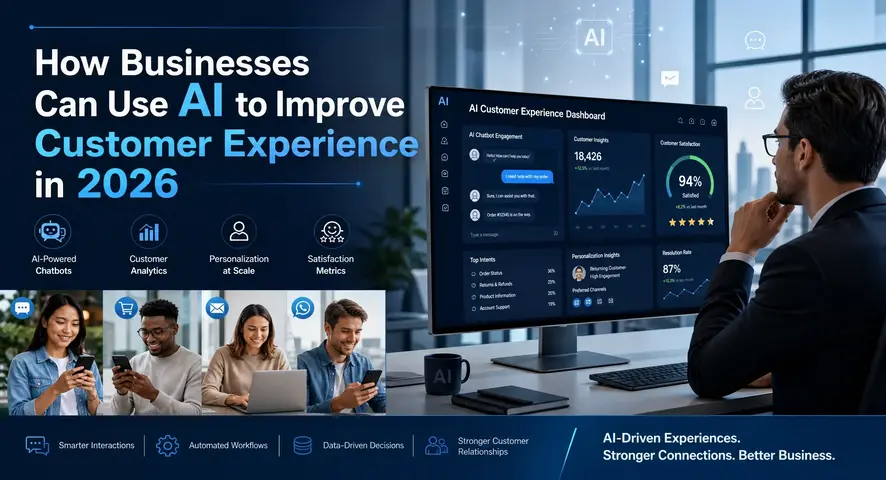
How Businesses Can Use AI to Improve Customer Experience in 2026
Customer expectations have never been higher. People want fast responses, personalized service, and seamless experiences across every channel and they'll leave for a competitor who delivers if you don't.
For many businesses, meeting these expectations at scale feels impossible. You can't hire enough people to respond instantly to every inquiry, personalize every email, or predict every customer's next need. At least, not without AI.
In 2026, AI has moved from being a futuristic concept to an essential business tool. Businesses of all sizes are using AI to transform how they engage with customers making interactions faster, smarter, and more personal than ever before. Today, many organizations are investing in AI business solutions to improve customer engagement, strengthen retention, and create seamless experiences across channels. In this guide, we'll walk through the most powerful ways AI is reshaping customer experience and how your business can start benefiting today.
What Is AI Customer Experience?
AI customer experience refers to the use of artificial intelligence technologies including machine learning, natural language processing, predictive analytics, and automation to personalize, streamline, and improve every interaction a customer has with your business.
Rather than replacing the human element of customer service, AI enhances it. It handles repetitive, time-consuming tasks so your team can focus on complex problems and meaningful conversations. It processes enormous amounts of customer data to surface insights no human could spot manually. And it enables businesses to deliver personalized experiences at a scale that simply wasn't possible before.
What's changed in 2026 is the accessibility of these tools. AI is no longer only available to large enterprises with big tech budgets. Small and mid-sized businesses can now implement AI-powered CX solutions through affordable, plug-and-play platforms that integrate with existing tools.
Why AI Is Transforming Customer Experience
Several forces are driving the rapid adoption of AI in customer experience:
- Rising expectations: Customers now compare their experience with your brand to the best experience they've had anywhere including major platforms like Amazon and Apple
- Volume challenges: As businesses scale, maintaining consistent, high-quality support becomes exponentially harder without AI assistance
- Competitive pressure: Businesses that use AI to improve CX gain a measurable advantage in retention, satisfaction scores, and lifetime value
- Data abundance: Every customer interaction generates data AI can turn that data into actionable personalization and predictive insights
Businesses are increasingly adopting AI automation for business to streamline customer interactions, improve response times, and deliver more efficient support experiences.
Key Ways Businesses Can Use AI to Improve Customer Experience
1. AI Chatbots for 24/7 Customer Support
One of the most widely adopted AI tools in customer experience is the AI chatbot. Unlike traditional rule-based bots that frustrate customers with rigid menus, modern AI chatbots powered by large language models can hold genuinely helpful conversations.
AI chatbots can handle FAQs, process returns, track orders, troubleshoot basic issues, and qualify leads all without requiring a human agent. They're available around the clock, respond instantly, and handle multiple customers simultaneously.
The key to successful chatbot deployment is knowing when to escalate. A well-designed AI support system can identify when a conversation requires human empathy or expertise and transfer it seamlessly to a live agent with full context preserved.
2. Personalization at Scale
Customers are far more likely to engage with a brand that knows who they are and what they need. AI makes this kind of personalization possible at scale. Delivering a personalized customer experience helps businesses build stronger relationships, increase engagement, and improve long-term customer loyalty.
By analyzing behavioral data pages visited, products viewed, purchase history, email engagement AI engines can deliver highly relevant product recommendations, personalized email content, dynamic website experiences, and targeted offers. What used to require large data science teams can now be automated with AI-powered personalization platforms.
The result is a customer experience that feels less like mass marketing and more like a trusted advisor who understands your preferences.
3. Predictive Analytics to Anticipate Needs
The most powerful shift AI enables in customer experience is the move from reactive to proactive. Instead of waiting for a problem to happen, AI can predict it and help you act first.
Predictive analytics models can identify which customers are showing signs of churn, which accounts are ready to expand, and which customers might need support based on usage patterns. This allows your team to reach out proactively turning potential negative experiences into positive touchpoints.
Early intervention based on AI predictions can dramatically reduce churn and increase overall customer satisfaction.
4. AI-Powered Customer Feedback Analysis
Your customers are constantly telling you how they feel through reviews, surveys, support tickets, and social media. The challenge is processing all of that feedback at scale and turning it into actionable insights.
AI sentiment analysis tools can read and categorize thousands of customer responses automatically, identifying recurring themes, urgent issues, and overall satisfaction trends in real time. This gives your team the ability to respond to problems faster and make product or service improvements based on real data not assumptions.
Instead of reading through hundreds of support tickets manually, your team gets a dashboard that shows exactly what customers are saying and how sentiment is trending.
5. Intelligent Self-Service Portals
Most customers prefer to solve their own problems if it's easy enough. AI-powered self-service portals make this possible by combining intelligent search with guided troubleshooting workflows.
Rather than a static FAQ page, an AI-driven knowledge base understands natural language queries and surfaces the most relevant answers. It can guide customers through step-by-step solutions based on their specific issue and learn from interactions to improve over time.
Reducing the need for live support not only improves customer satisfaction it also frees up your support team to focus on the complex issues where human expertise truly adds value.
6. Omnichannel AI Integration
Today's customers interact with businesses across multiple channels like email, website chat, social media, phone, and mobile apps. They expect their experience to be consistent and connected regardless of which channel they use.
AI enables true omnichannel customer experience by creating unified customer profiles that aggregate data from every touchpoint. When a customer who emailed support yesterday opens a chat conversation today, the AI-powered system already knows their history and context and no need to repeat themselves.
This continuity dramatically improves satisfaction and reduces the friction that causes customers to give up on getting help.
7. Voice AI and Conversational Interfaces
Voice AI is maturing rapidly. AI-powered voice assistants are now capable of handling nuanced customer conversations with natural language understanding, reducing the reliance on traditional phone-based support queues.
For industries like healthcare, financial services, and e-commerce, voice AI can handle appointment scheduling, account inquiries, and order updates at a scale and speed no human team could match. The key is building voice AI that sounds natural, stays on topic, and hands off gracefully when human intervention is needed.
8. AI for Customer Onboarding and Education
Poor onboarding is one of the leading causes of early churn. If a customer doesn't quickly understand how to get value from your product, they leave often before they ever realize the potential.
AI can personalize the onboarding experience based on each user's behavior, role, and goals. In-app AI guidance can surface the right tips at the right moment. Automated email sequences can adapt based on what actions the user has and hasn't taken.
The result is a faster time-to-value for new customers and significantly lower early churn rates.
How to Implement AI for Customer Experience
- Audit your current CX touchpoints and identify where friction, delays, or inconsistencies occur
- Start with one high-impact, well-defined use case such as a support chatbot or email personalization
- Choose AI tools that integrate cleanly with your existing CRM, helpdesk, and marketing platforms
- Train your team to work alongside AI tools, not compete with them
- Measure results with clear KPIs: response time, satisfaction score, resolution rate, churn rate
- Iterate continuously based on customer feedback and performance data
Challenges and How to Overcome Them
- Data privacy: Ensure all AI implementations comply with applicable data regulations (GDPR, CCPA, etc.) and communicate your data practices clearly to customers
- Over-automation: Avoid removing the human element entirely some situations genuinely require empathy and judgment
- Integration complexity: Work with vendors who offer strong API support and implementation assistance
- AI accuracy: Monitor AI outputs regularly and build in feedback loops to improve model performance
- Customer trust: Be transparent about when and how AI is used in customer interactions
Why Choose GrowthMak for AI Enablement Services
GrowthMak helps businesses design and implement AI customer experience strategies that are practical, scalable, and aligned with real business goals. From AI chatbot deployment and personalization engines to sentiment analysis and omnichannel integration, GrowthMak's AI enablement services are designed to deliver measurable improvements in customer satisfaction and loyalty.
- AI strategy development tailored to your industry and customer base
- Chatbot and virtual assistant implementation
- Personalization engine setup and integration
- AI analytics and customer feedback analysis
- Ongoing optimization and performance monitoring
If you're ready to transform your customer experience with AI, GrowthMak can help you get there faster and smarter.
Final Thoughts
AI is reshaping what great customer experience looks like. Businesses that embrace these tools in 2026 won't just keep up with expectations, they'll set the standard. The good news is that implementing AI for customer experience doesn't have to be complex or expensive.
Start with a clear goal, choose the right tool for the right use case, and measure your progress. Whether you're improving response times with a chatbot, reducing churn with predictive analytics, or personalizing communications at scale, each step forward builds a stronger, more loyal customer base.
The future of customer experience is intelligent, proactive, and personal. With AI, that future is already here.
FAQs
AI improves customer experience through personalization, automation, and predictive insights. Businesses use AI for chatbot support, personalized recommendations, proactive churn prevention, sentiment analysis, and omnichannel consistency delivering faster, more relevant experiences at scale.
Popular AI tools for customer service include Intercom and Drift for chatbots, Salesforce Einstein and HubSpot AI for CRM and personalization, Zendesk AI for support automation, and tools like Qualtrics and Medallia for AI-powered feedback analysis.
AI chatbots provide instant, 24/7 responses to common customer queries without requiring human agents. They handle FAQs, order tracking, basic troubleshooting, and appointment scheduling, reducing wait times and freeing human agents to focus on complex, high-value interactions.
AI is designed to augment, not replace, human agents. While AI handles repetitive tasks effectively, human agents are essential for complex issues, emotional situations, and interactions that require genuine empathy and judgment. The best CX strategies combine AI efficiency with human expertise.
AI personalizes customer experience by analyzing behavioral data purchase history, browsing patterns, email engagement to deliver individually tailored content, product recommendations, and communications. The more data the AI has access to, the more precisely it can match each customer's preferences and needs.
Yes. Many AI customer experience tools are designed with small businesses in mind, offering affordable plans and easy integrations. Starting with a single use case such as a FAQ chatbot or personalized email automation can deliver meaningful results without a large upfront investment.
AI helps reduce customer loss by identifying customers who may stop using your products or services before they leave. Predictive models analyze behavior patterns that signal disengagement, allowing your team to proactively reach out with personalized offers, support, or educational resources. Early intervention is more effective and cost-efficient than trying to win back customers who have already left.
Written by Growthmak Team · B2B Growth Specialists
All blogs