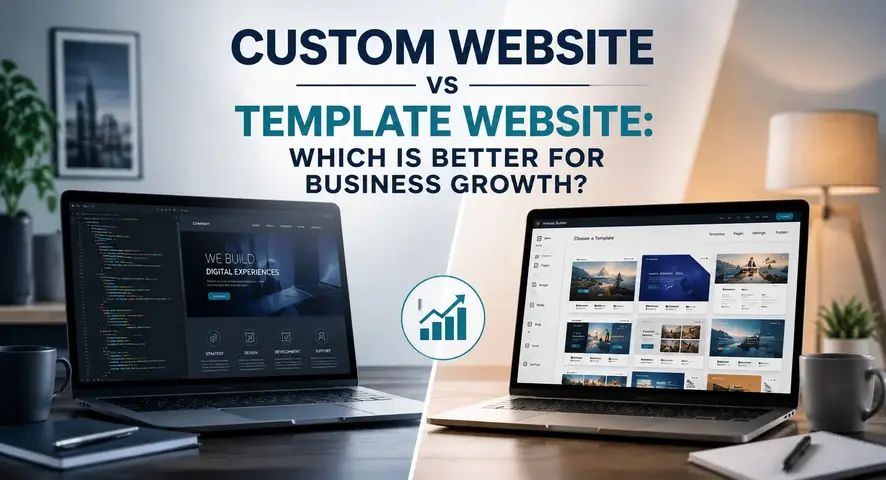
Custom Website vs Template Website: Which Is Better for Business Growth?
When it comes to building a website for your business, one decision can shape everything that follows whether you go custom or use a template. At first glance, both options seem reasonable. Templates are faster, cheaper, and easy to set up. Custom websites take more time and investment but are built specifically for your goals.
So which one is actually better for business growth? The honest answer is: it depends. But there are clear situations where one significantly outperforms the other and choosing the wrong one at the wrong time can quietly hold your business back.
In this guide, we'll break down both options clearly, compare them across the factors that matter most, and help you make a confident decision.
What Is a Custom Website?
A custom website is built from scratch by web developers and designers. There are no pre-designed themes or templates, every aspect of the site, from the layout and functionality to the code structure and user experience, is created specifically for your business.
Custom websites are typically built using technologies like React, Next.js, or other frameworks, with a backend tailored to your specific data and workflow needs. Because everything is purpose-built, you get exactly what you need, nothing more, nothing less.
Custom development is common among growing businesses, enterprises, and any company where the website is a core part of the customer experience or revenue model.
What Is a Template Website?
A template website is built on a pre-designed theme or layout that you customize with your own content, colors, fonts, and branding. Popular platforms like WordPress, Wix, Squarespace, and Shopify offer thousands of templates that can be set up relatively quickly with minimal technical knowledge.
Template websites lower the barrier to entry for getting online. Many small businesses, startups, and solo entrepreneurs use them to launch quickly without a large upfront investment.
However, customization is limited by what the template allows. You're working within someone else's design and code structure, which can create constraints as your needs evolve.
Custom Website vs Template Website: Key Differences
| Key Difference | Custom Website | Template Website |
|---|---|---|
| Design and Branding | A custom website gives complete creative freedom. Typography, layout, animations, and colors are designed around your brand, creating a unique experience that stands out. | Template websites often resemble many others using the same theme. While colors and images can change, the structure usually stays similar, limiting brand uniqueness. |
| Performance and Speed | Custom websites use only the code needed for your business, resulting in faster loading pages and better user experience. | Template websites often include extra plugins and scripts, making pages heavier and requiring ongoing optimization. |
| SEO Capabilities | Custom websites offer full technical SEO control, including URL structure, page speed, schema markup, structured data, canonical tags, and Core Web Vitals optimization. | Template platforms have improved SEO features but still have limitations. Some restrict metadata access or create inefficient code that affects crawling and indexing. |
| Scalability | Custom websites are built for growth, making it easier to add features, integrations, and handle higher traffic over time. | Template websites work well initially, but growing businesses may face limitations when adding advanced functionality or scaling traffic. |
| Cost and Timeline | Custom websites require more time and investment but often deliver better long term ROI through performance, branding, and conversions. | Template websites are quicker and cheaper to launch, making them ideal for businesses with tight budgets or early stage ideas. |
Pros and Cons of Custom Website Development
Choosing custom website development gives businesses greater flexibility to build a website that matches their exact goals and brand identity. It supports better website performance, advanced functionality, and stronger SEO optimization, helping businesses improve visibility and user experience. A custom-built website also offers better scalability, making it easier to expand features as business needs grow.
Pros of Custom Website Development:
- Unique website design and complete control
- Better website speed and performance
- Greater SEO flexibility and customization
- Easy scalability for future business growth
Cons of Custom Website Development:
- Higher upfront investment
- Longer development timeline
- Ongoing dependency on developers for updates
A custom solution works best for businesses focused on long-term growth, performance, and brand uniqueness.
Pros and Cons of Template Website Design
A template website design helps businesses launch quickly while keeping development costs lower. It offers a simple way to manage website content and maintain functionality without heavy technical involvement. However, template-based websites may face limitations in customization, SEO performance, and scalability as business requirements increase.
Pros of Template Website Design:
- Quick website launch
- Budget-friendly development cost
- Easy to manage and update
Cons of Template Website Design:
- Limited design uniqueness
- Bloated code may affect website performance
- Scalability challenges over time
- Limited SEO customization options
Template websites are suitable for businesses looking for an affordable and fast website solution.
Which Is Better for SEO: Custom or Template?
If SEO is a priority for your business and it should be, custom websites have a clear edge. Here's why:
- Clean, lean code is easier for search engines to crawl and index
- Full control over page speed, which is a confirmed Google ranking factor
- Ability to implement advanced schema markup and structured data
- No platform restrictions on robots.txt, sitemaps, or metadata
- Better Core Web Vitals scores due to optimized code
Template platforms like WordPress can be optimized for SEO, but it requires significant effort and careful plugin management. Platforms like Wix and Squarespace have improved, but still offer less SEO flexibility than a well built custom site.
Which Is Better for Business Growth?
The answer here depends heavily on your business stage:
Early stage or pre revenue: A template website is perfectly fine. Focus on validating your product or service, not on engineering the perfect site.
Growth stage business: As traffic, leads, and revenue increase, a custom website becomes a competitive advantage. Performance, conversion optimization, and brand differentiation all improve outcomes.
Enterprise or scaling business: A custom website is essential. The complexity of operations, integrations, and user experience requirements simply cannot be met by template platforms.
If your website is actively driving leads and revenue or should be, a custom build will outperform a template at scale.
When Should You Choose a Custom Website?
A custom website makes sense when your website plays a major role in business growth. If your site is responsible for generating leads, driving sales, or creating strong brand experiences, a custom build offers the flexibility and performance needed to support long term success.
You should choose a custom website if:
- Your business relies on the website as a primary lead generation or sales channel
- You need unique functionality that templates cannot support
- Brand identity and differentiation are strategic priorities
- You're scaling quickly and need a site that can grow with you
- Performance and page speed are critical to your user experience
Choosing a custom website is an investment, but for businesses focused on growth, conversions, and long term scalability, the benefits often outweigh the upfront cost.
When Should You Choose a Template Website?
A template website is a practical choice for businesses that need to launch quickly without investing heavily in development. It works especially well when your website requirements are simple and speed matters more than deep customization.
You should choose a template website if:
- You're just starting out and need to launch quickly
- Budget is tight and speed to market matters more than customization
- Your website is primarily informational with minimal functionality needs
- You're testing a concept before committing to a larger build
For early stage businesses, a template website can provide everything needed to establish an online presence while keeping costs low and timelines short.
Why Choose GrowthMak for Custom Website Development
GrowthMak builds custom websites that are purpose-designed for performance, conversion, and long-term growth. Whether you're ready to move beyond a template or starting fresh with a custom build, GrowthMak delivers solutions that align with your business goals.
- Fully custom design and development tailored to your brand
- Performance-first approach with optimized code and speed
- SEO-friendly architecture built in from day one
- Scalable structure designed to grow with your business
- Conversion-focused UX that turns visitors into customers
If your current website isn't performing the way your business deserves, GrowthMak can help you build one that does.
Final Thoughts
Both custom websites and template websites have their place. Templates are a smart, practical choice when you're just getting started or operating within a tight budget. They let you get online quickly and start generating traction.
But as your business grows and your website becomes a more critical business asset, the limitations of templates become harder to ignore. Custom website development gives you the flexibility, performance, and control needed to truly scale and to stand out in a competitive digital landscape.
The best website for your business is the one that aligns with where you are today and where you're heading tomorrow.
Frequently Asked Questions
What is the difference between a custom website and a template website?
A custom website is built from scratch to match your exact business requirements, offering complete design freedom and technical control. A template website uses pre built layouts that you customize with your own content and branding, typically at a lower cost and faster launch time.
Is a custom website better for SEO?
Generally, yes. Custom websites allow full technical SEO control, clean code, optimized page speed, proper schema implementation, and no platform restrictions. While template platforms like WordPress can be SEO optimized, custom builds offer more flexibility and better baseline performance.
How much does a custom website cost?
Custom website costs vary widely based on complexity, features, and the agency or development team you work with. Small business custom sites might start from a few thousand dollars, while enterprise builds can run into tens of thousands. The investment typically pays off through better conversions and long term scalability.
Can I switch from a template to a custom website later?
Yes, but it usually involves rebuilding rather than migrating. It's best to plan for this transition strategically, ideally when your business is growing and the investment makes clear financial sense. A good web development agency can help you plan the migration with minimal disruption.
Which is better for a small business, custom or template?
For most small businesses just starting out, a well built template website is a practical and cost effective solution. As your business grows and your website becomes a key driver of leads and revenue, investing in a custom build becomes increasingly worthwhile.
Do template websites rank on Google?
Yes, template websites can rank on Google when properly optimized. However, technical limitations of some platforms can make it harder to achieve top rankings compared to well built custom sites, especially in competitive markets where page speed and technical SEO are differentiators.
What are the biggest limitations of template websites?
The main limitations include restricted design flexibility, potential performance issues due to bloated code, limited technical SEO control on some platforms, scalability constraints as your business grows, and a lack of uniqueness that can make it harder to differentiate your brand online.
Written by Growthmak Team · B2B Growth Specialists
All blogs