


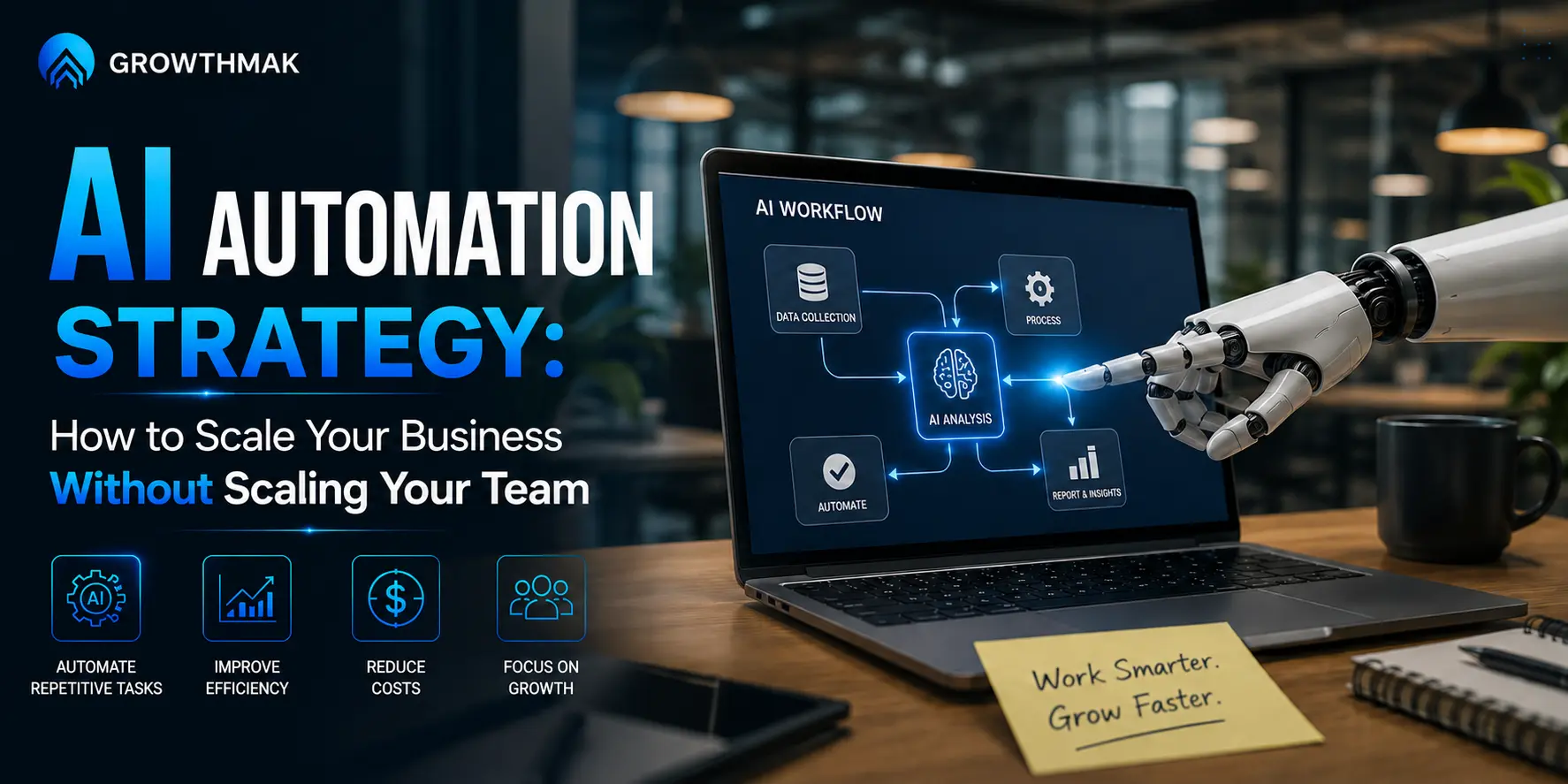
AI Automation Strategy: How to Scale Your Business Without Scaling Your Team

A founder tells you they need to hire, and there is one question worth asking before anyone writes a job description.
What does this role do that you cannot automate? Most of the time there is a long pause, not because the answer is obvious, but because most owners have never separated this function needs a person from this function needs to be done.
Those are different problems, and the gap between them is wider than most businesses realize. A smart AI Automation strategy lives in that gap. It lets you absorb more volume without adding the fixed cost, complexity and management overhead that every new hire brings.
The businesses pulling ahead in 2026 are the ones that stopped treating automation as a productivity assistant and started using it to redesign how work moves through the company. That shift, from helping people do tasks faster to removing the tasks entirely, is what separates a lean operation from a bloated one.
Here is what a real strategy decides, in order:
- Which work needs a person and which just needs doing
- Which processes to automate first
- How to prove it works before you scale
- Which tools let non-technical staff build
- How to govern it once it runs
- How to measure the return
Skip the strategy and you get scattered tools that impress in a demo and quietly break in production, which is how most automation budgets get wasted.
What an AI Automation Strategy Really Does
An AI Automation strategy lets you grow operations without growing payroll at the same pace. Instead of hiring for every new bit of volume, you move repetitive, rule-heavy, measurable work off your team and onto automated workflows, then redirect people to work that genuinely needs judgment. The approach is simple: separate the function from the person, automate the highest-volume repeatable tasks first, prove the return on one process, then scale. The condition that sets your first move is where your volume and pain are highest. Start there, not with the flashiest tool, and let a single proven win fund the next one.
Why Hiring First Is the Expensive Reflex
Growing a business used to mean hiring more people to handle more work, and that model still exists. It is just getting harder to justify.
Operational complexity compounds as you scale. More leads to track, more follow-ups to send, more inquiries to answer, more data to make sense of. At some point the manual processes that worked when you were smaller become the thing holding you back.
The instinct is to answer that complexity with people, because that is how businesses have always grown. But cost goes up and operations get more tangled before they get more efficient, and each new hire brings its own coordination overhead on top of the salary.
Hiring solves the immediate crunch, but it adds fixed cost and complexity before it adds efficiency. Automating the repetitive work is what lets you break that ceiling without a proportional jump in headcount, which is the whole point of a scalable operation.
There is a timing angle too. A new hire takes weeks to recruit, onboard and bring up to speed, and the cost stays on the books whether volume is high or low that month. A workflow, by contrast, absorbs a spike the day it goes live and costs the same whether it runs ten times or ten thousand.
This is not about replacing people. It is about not spending a salary on work that never needed a person in the first place, so the people you do hire are working on things that actually move the business.
The AI Automation Strategy, Step by Step
Work this AI Automation strategy in order. Each step builds on the one before it, and each ties back to a business outcome rather than a tool you happened to like.
1. Separate Needs a Person from Needs to Be Done
Start by splitting every function into two questions: does this need human judgment, or does it just need to happen reliably? That single distinction decides what belongs on your team and what belongs in a workflow.
Most roles are a mix. A person spends part of their week on genuine judgment and the rest on repetitive tasks that drain their time. The goal is not to remove the person, it is to remove the drain and redirect them to the work only a human can do.
- List the recurring tasks inside each role
- Mark which need judgment and which need consistency
- Target the consistent, repeatable ones for automation
Run this exercise honestly and the answer often surprises people. A role that felt like it needed a full-time hire turns out to be sixty percent repeatable work that a workflow can absorb, leaving a part-time slice of genuine judgment that an existing team member can cover.
2. Automate the Rule-Heavy, High-Volume Work First
Point your first efforts at rule-heavy, high-volume, measurable work, because that is where business process automation delivers the fastest, clearest return. Approvals, data entry, scheduling, follow-ups and reporting are classic candidates.
The departments that benefit most are the ones built on repeatable processes. Sales, support, finance, operations and marketing all run high volumes of approvals, follow-ups and reporting, which is exactly the terrain automation was made for.
Choose processes with a clear success measure so you can prove the win. If you cannot say what good looks like in numbers, you cannot tell whether the automation helped, and you will struggle to justify scaling it.
AI Workflow Automation shines here because it connects several steps that used to need a person passing work along. A lead comes in, gets scored, gets routed and gets a first response, all without someone manually stitching each stage together.
3. Start with One Process and Prove ROI
Automate a single workflow end to end before you touch anything else, then measure the return on investment over a set window. The best approach is to begin with one process, measure results, and scale gradually as the gains become clear.
This discipline protects you from the scattered-tools trap. A single proven automation that saves real hours is worth more than ten half-finished experiments, and the win funds the next project with evidence rather than hope.
It also builds internal buy-in. When a team sees one workflow reliably remove a tedious task and give hours back, resistance to the next automation fades. Proof beats persuasion, and the first project is where you earn it.
4. Use No-Code Platforms to Move Fast
Lean on no-code development platforms so non-technical staff can build and refine workflows without waiting on engineers. Visual builders with drag-and-drop steps and pre-built connectors have put workflow automation within reach of the people who actually run the process.
This is why the barrier fell. Businesses can go from idea to working automation in days or weeks rather than months, and without a six-figure software budget. Intelligent Workflow Automation is no longer reserved for teams with in-house developers.
Costs fell on the technical side too, which is part of why 2026 is a tipping point. The people closest to a process are usually the best placed to automate it, because they know its exceptions and edge cases better than any outside developer would.
5. Add Governance and Human Oversight
Put guardrails in place before you scale, not after something goes wrong. As automation takes on more decisions, governance, audit trails and human oversight become the difference between reliable systems and silent failures.
Set clear limits on what a workflow can do on its own. Anything that touches money, customer data or public communication should require a human approval step, so a single bad input cannot cause outsized damage before someone catches it.
Keep a human in the loop on judgment calls and edge cases, and give every workflow a clear owner. An automation nobody owns is one nobody notices when it drifts, and drift in a high-volume process compounds quickly.
This is where good AI Automation Services earn their place. The right partner does not just wire up tools, it designs the oversight, ownership and audit trails that keep Business Automation Solutions dependable as they take on more of your operation. That design work is what turns a fragile demo into a system you can trust with real volume.
What to Automate, and What to Leave Alone
The functions that pay off first are the repeatable, rule-heavy ones: inquiry triage, content scheduling, lead qualification and internal reporting. These are high volume, easy to measure and low on judgment, which is exactly the profile automation handles best. More than half of businesses running automation have already moved at least one of these off a human's plate.
Leave the judgment work with people. Strategy, sensitive customer conversations, creative decisions and anything requiring real context and accountability still need a human. The aim of AI for Business is to hand people more of that work by clearing the repetitive tasks off their plate.
The test for any task is honest and quick. Ask whether the work follows clear rules, happens often, and can be measured. Three yeses point to automation. A no on any of them, especially the rules test, usually means a person should stay in charge, at least for now.
What an AI Automation Strategy Will Not Do
Automation will not fix a broken process. If a workflow is badly designed, automating it just makes the mess happen faster, so clean up the process before you wire it up.
It will not remove the need for judgment, and it will not run itself unattended forever. Workflows drift as tools, data and rules change, so they need ownership and maintenance the same way a website does. Treat automation as a system you tend, not a switch you flip.
It also will not deliver value from tools alone. Buying a platform and hoping usage follows is how automation budgets get wasted. The value comes from the strategy around it: choosing the right process, proving the return and governing it well. The software is the easy part.
Final Thoughts on AI Automation
The verdict is simple: scale by removing repetitive work from your team, not by hiring for every new bit of volume. The businesses pulling ahead separate what needs a person from what merely needs doing, and automate the second category without apology.
What changes your plan is where your volume and pain concentrate. A services firm drowning in follow-ups starts in a different place than a store buried in order updates, so let your own bottleneck choose the first project rather than copying someone else's roadmap.
Start with three moves: list the repetitive tasks inside your busiest role, pick the highest-volume one with a clear success measure, and automate it end to end before you scale. One proven win is worth more than a whole roadmap of untested ideas.
Scale Smarter with Growthmak
Growthmak is an AI-native agency that builds automation the strategic way, starting from your bottleneck rather than a tool catalog. Our automation services and AI enablement approach teams help you choose what to automate, prove the return and govern it as it scales, and you can see our work for a sense of how we operate.
Visit www.growthmak.com to request an automation audit and find the single workflow worth automating first.
What Is AI Automation in Simple Terms?
AI automation uses intelligent software to handle repetitive business tasks, make simple decisions, and streamline workflows. It improves efficiency, reduces manual effort, increases consistency, and allows teams to focus on higher-value strategic work.
Can You Really Scale a Business Without Hiring?
Yes, AI automation helps businesses handle growing workloads without increasing headcount at the same pace. Automating repetitive tasks improves productivity, reduces operational costs, and enables teams to focus on customer service, strategy, and business growth.
What Should a Small Business Automate First?
Start by automating repetitive tasks like lead management, appointment scheduling, customer support, invoicing, and follow-ups. These processes deliver quick efficiency gains, reduce manual work, improve accuracy, and provide measurable returns with minimal implementation effort.
Do I Need Technical Skills to Use AI Automation?
No. Modern no-code AI automation platforms allow businesses to build workflows using visual tools and pre-built integrations. Technical expertise is only needed for advanced, enterprise-level automations or complex multi-system integrations.
How Do I Measure the ROI of Automation?
Measure automation ROI by comparing time saved, reduced costs, fewer errors, and productivity improvements against implementation expenses. Tracking these metrics over several weeks provides clear evidence of business value and operational efficiency.
Will AI Automation Replace My Employees?
Generally, no. AI automation replaces repetitive tasks rather than employees. It enables teams to spend more time on strategy, creativity, customer relationships, and decision-making while improving productivity and overall business performance.
How Do I Keep AI Automation Safe and Reliable?
Maintain reliable AI automation through regular monitoring, human oversight, security controls, audit logs, and clear governance. Testing workflows and reviewing performance ensures accurate results while reducing operational risks and maintaining customer trust.
How Long Does It Take to See Results from Automation?
Many businesses see measurable automation benefits within a few weeks, especially for repetitive tasks. The timeline depends on workflow complexity, implementation quality, and business processes, with simple automations typically delivering the fastest return on investment.
Related Blogs

.svg)

Get Started with Growthmak Today!
Unlock your marketing potential with our expert team.