Your Website Looks Great. Why Isn't It Bringing You Customers?
You just launched a redesign that everyone loves. The layout is clean, the photography is sharp, and the branding finally feels like you.
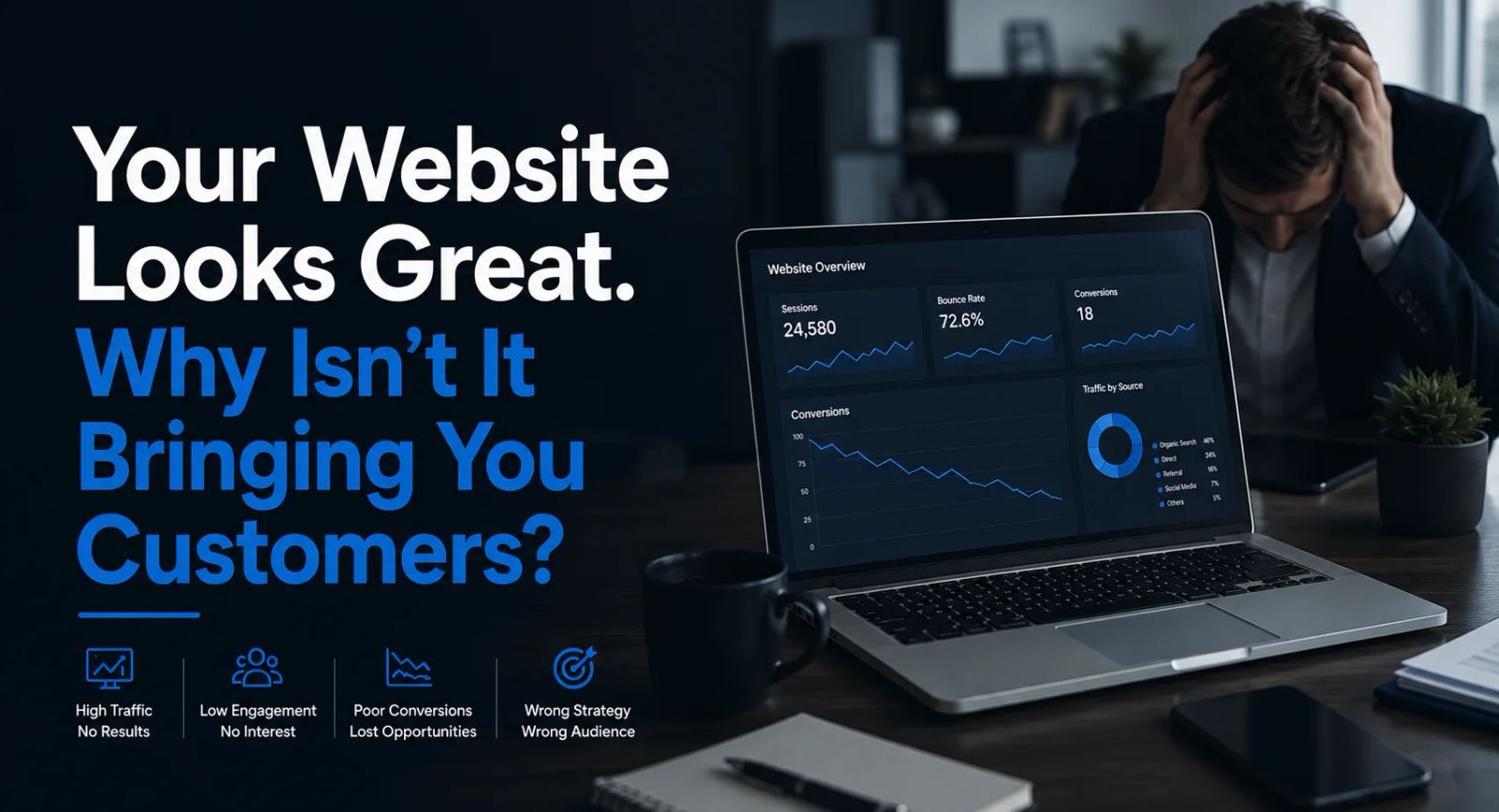
Traffic is climbing too. The blog is ranking, the ads are running, and people are landing on the site every single day.
Somewhere between those two facts sits the real problem, and it rarely has anything to do with color choices or font pairings.
The phone still isn't ringing. The contact form sits empty. That gap almost never comes from bad design. It comes from a website conversion problem, the mechanics that decide whether a visitor becomes a lead or just leaves.
Here is what actually decides that outcome:
- How fast your value proposition lands
- Whether your call to action is obvious
- How much friction sits inside your forms and pages
- Whether anything on the page earns the visitor's trust
Why Isn't Your Website Converting Visitors Into Customers
Most of the time, a site that gets traffic but no customers is not a design failure. It is a conversion failure, meaning visitors arrive, look around, and leave before taking any action that matters to the business. The fix usually sits in five places: a value proposition that doesn't land in the first few seconds, a call to action that hides instead of leads, a landing page that breaks the promise made by the ad, a form that asks for too much too soon, and a follow-up process that never happens after the click. Fix those five and the same traffic starts producing customers.
The Gap Between Website Design and Website Conversion
Website design earns the compliments. It is visual, easy to evaluate, and everyone on the team has an opinion about it. Website conversion earns none of that attention because it lives in the parts nobody screenshots, like form length, page speed, and what happens after someone clicks.
That is why a site can look better than ever while producing fewer leads than the outdated version it replaced. More traffic makes this worse, not better, because it just sends more visitors through the same broken steps.
Fixing this rarely requires starting over. It requires treating conversion rate optimization as its own discipline, separate from the visual refresh, with its own goals and its own testing.
A homepage that wins design awards can still convert at a fraction of a plainer one, because judges score visuals and visitors score clarity. Those two audiences are almost never looking for the same thing.
Treat website conversion as a number you check every week, the same way you check traffic. A number nobody tracks is a number that quietly gets worse.
None of this means design does not matter. It means design earns its value by making the conversion path clearer, not by winning attention for its own sake.
Seven Reasons Your Website Traffic Isn't Turning Into Customers
These are the seven places most businesses lose visitors before they ever become a customer, in roughly the order they show up in a typical audit. Not every business will have all seven working against it, but most will recognize at least three.
1. Your Value Proposition Doesn't Land in the First Five Seconds
Visitors decide almost immediately whether a page is worth their time. If the headline explains a feature instead of a result, most of them leave before scrolling.
A strong value proposition names the specific outcome the visitor gets and who it is for, in plain language, above everything else on the page.
Test the headline by covering everything else on the page and asking a stranger what the business actually does for them in ten seconds. If they hesitate, the value proposition needs a rewrite before anything else gets touched.
- The specific result the visitor gets, not just the feature
- Who the offer is for, stated plainly
- One sentence a stranger could repeat back accurately
2. Your Calls to Action Are Weak, Buried, or Missing
A call to action that says Submit or Learn More gives the visitor nothing to picture. It describes an action, not a result.
Placement matters just as much as wording. One strong call to action repeated at natural stopping points outperforms five different ones competing for attention.
| Weak Call to Action | Why It Underperforms | Stronger Alternative |
|---|---|---|
| Submit | Describes a form action, not a benefit | Get My Free Quote |
| Learn More | Adds a step with no clear reward | See Pricing |
| Click Here | Names nothing about the outcome | Start My Free Trial |
Color and size help a call to action stand out, but wording decides whether it earns the click. A specific promise beats a generic instruction almost every time, and it costs nothing to test both versions against each other.
3. Your Landing Page Doesn't Match What the Visitor Was Promised
When an ad promises a specific offer and the landing page opens on a general homepage, the visitor feels misled, even if nothing was technically false. That mismatch drives the bounce.
Every paid or organic entry point deserves its own page that mirrors the exact language the visitor just read, built around one goal and one call to action.
If your pages were never built with website conversion in mind, copy edits only go so far. That is usually a sign the site needs a rebuild from a dedicated website development agency rather than another round of headline tweaks.
Match the headline on the landing page to the exact words used in the ad or the search result that brought the visitor there. That single change alone often lifts website conversion more than a full visual redesign.
4. Your Forms Ask for Too Much, Too Soon
Every additional field is a new reason to abandon the form. Asking for a phone number, company size, and budget before the visitor has any reason to trust you will lose people who were otherwise ready to convert.
Save deeper qualifying questions for after the first contact. Lead generation improves when the first ask is small and the value is obvious.
- Ask only for a name and email or phone on the first form
- Explain what happens immediately after someone submits it
- Remove fields that exist for internal reporting, not the visitor
Every field removed from a form is a field you no longer have to justify. If a question is not needed for the first conversation, ask it after the call or the demo instead, once trust already exists.
5. Your Site Fails the Mobile and Load Speed Test
A slow, cluttered mobile experience pushes visitors back to search results before the page finishes loading. On a small screen, every extra tap is a chance to lose someone.
A good user experience on mobile is not a nice-to-have layer on top of the desktop site. For most businesses, it is the primary way people meet you, and it decides whether they stay long enough to convert.
Run the page through a mobile speed check and watch someone unfamiliar with the business try to complete the form on their own phone. Most of the friction shows up in that single test, faster than any audit slide deck.
- Test the contact form on an actual phone, not just a browser preview
- Compress images so the page finishes loading before patience runs out
- Keep buttons and links large enough to tap on the first try
6. You Have No Visible Trust Signals
Visitors who don't recognize your brand look for proof before they hand over contact information. Reviews, client logos, certifications, or a clear phone number and address all do that work quietly.
A page with no trust signals asks for a leap of faith. A page with two or three well-placed ones asks for a much smaller one.
None of these signals need to be elaborate. A short client quote with a real name attached usually outperforms a long list of vague testimonials with no faces behind them.
- A short client quote with a real name and a real result
- A visible phone number or address rather than a contact form only
- A certification, guarantee, or association logo relevant to the offer
7. Your Sales Funnel Has No Follow-Up After the Click
Getting the form submitted is the start of the sales funnel, not the end of it. If the only thing that happens next is a generic autoresponder, most leads go cold within days.
A defined follow-up sequence, even a simple one, converts a share of the leads that a silent inbox would have lost for good.
Even a short sequence of two or three follow-up messages, spaced a few days apart, recovers leads that a single autoresponder would have lost. The sales funnel does not end at the form. It starts there.
- A confirmation message that sets a clear expectation for what happens next
- A short follow-up sequence spaced a few days apart
- A simple way for a lead to reach a real person if they have a question
Is It a Website Traffic Problem or a Website Conversion Problem?
Rising traffic with flat leads usually points to conversion, not traffic. The visitors are already showing up. Something on the page is turning them away.
| Signal | Traffic Problem | Website Conversion Problem |
|---|---|---|
| Visits are climbing month over month | Not the likely cause | Yes, more people hit the same broken steps |
| Bounce rate is high on entry pages | Possible, wrong audience or keywords | Possible, mismatched landing page |
| Forms are started but rarely completed | Not the likely cause | Yes, a conversion issue |
| Leads convert well but too few people arrive | Yes, the likely cause | Not the likely cause |
Start with the page that carries the most traffic, since that is where a small conversion fix produces the largest number of new leads. Fixing a rarely visited page first wastes the analysis even when the fix itself is correct.
A heatmap or session recording, paired with basic web analytics, usually confirms which one you are dealing with within a week of data.
From there, A/B testing on individual elements, one at a time, replaces guesswork with evidence.
Document whatever you learn, even when a test fails to move the number. A failed test still rules out one explanation and narrows the next one down.
What Website Conversion Optimization Won't Fix
Website conversion optimization cannot repair a mismatch between your offer and the audience arriving on the page. If paid traffic is pulling in the wrong buyers, no headline rewrite fixes that.
It also will not save a page for a product or price that visitors have already decided against elsewhere. Optimization removes friction. It does not manufacture demand that was never there.
A website conversion audit also cannot substitute for a sales process that never follows up. The best page on the internet still needs someone to answer the phone or reply to the form within a reasonable window.
Final Thoughts
A website that looks great and still isn't producing customers has a website conversion problem, not a design problem, in almost every case.
That verdict flips only when the traffic itself is mismatched to the offer. Check that first, then work through the value proposition, calls to action, forms, and follow-up in order.
Start with the page that gets the most traffic and the fewest conversions. Fixing that one page usually pays for the rest of the audit.
None of these fixes require a brand new budget line or a full rebuild on their own. Most of them simply require an afternoon, a willingness to test, and a page you are willing to change more than once.
Ready to Turn Website Traffic Into Customers? Explore Growthmak
Growthmak works with businesses that already have the traffic and need the site itself to start earning it, through structural fixes rather than another visual refresh.
If your pages need a rebuild around outcomes instead of aesthetics, Growthmak's website development team can start with a conversion audit before the next redesign.
If your website is attracting traffic but not generating enough leads, Growthmak can identify the SEO, conversion, and structural gaps limiting your growth.
Book a 30-minute growth call or request a website growth audit to uncover the opportunities that can turn more traffic into customers.
Frequently Asked Questions
Your website may not generate leads because the message, offer, or call to action does not match visitor expectations. Simplify navigation, place a clear action above the fold, highlight benefits instead of features, and reduce friction so visitors can quickly understand the next step.
Traffic without customers usually indicates a conversion issue rather than a traffic problem. Improve your landing pages with stronger calls to action, clearer value propositions, trust signals, and shorter forms to help visitors confidently take the next step toward becoming customers.
Improve website conversion by reducing friction, simplifying forms, strengthening headlines, and placing a clear call to action above the fold. Test one improvement at a time, optimize page speed, and ensure your website delivers a seamless experience across desktop and mobile devices.
Convert visitors into customers by clearly communicating your value, building trust with testimonials or proof, and making the next action simple. Use compelling calls to action, minimize unnecessary form fields, and respond quickly to inquiries to maximize conversion opportunities.
Visitors often leave when pages load slowly, messaging is unclear, or calls to action are difficult to find. Reduce distractions, improve page speed, present a compelling value proposition immediately, and make it easy for users to complete their desired action.
Generate more website leads by optimizing existing pages before increasing traffic. Use dedicated landing pages, shorten forms, place strong calls to action prominently, and add trust signals like testimonials or guarantees to encourage more visitors to contact your business.
A good website conversion rate depends on your industry, audience, and goals. Instead of comparing with general benchmarks, measure performance against your historical results and focus on continuous improvement through testing, optimization, and better user experience across key landing pages.
Yes. Website design directly influences conversion by improving usability, readability, and user confidence. Fast-loading pages, intuitive layouts, clear navigation, and visible calls to action help visitors complete desired actions, while confusing or cluttered designs reduce conversion performance significantly.
Conversion rate optimization may show results within a few weeks for high-traffic websites, while lower-traffic websites often require several weeks or months. Consistent testing, sufficient visitor data, and measuring one change at a time produce the most reliable optimization results.
Written by Growthmak Team · B2B Growth Specialists
All blogs